Top HIPAA Compliant App Builders to Launch Custom Healthcare Apps Faster than Ever [2026]

Most no-code platforms promise speed. But ask for anything past a form and a login screen and they drop you into limitations, compliance gaps, and vendor lock-in. Build for real clinicians and patients, and those gaps turn into operational risk.
This post is for builders done hacking around templates. Maybe you're sizing up your first healthcare app builder. Maybe you're trying to escape the one quietly draining your runway. Either way: what are teams actually shipping in healthcare, and why do most platforms stall when real clinical work shows up? Specode is our answer, and we'll show the work.
Key takeaways
- Most no-code platforms stall the moment clinical logic or HIPAA-level compliance shows up. Templates were built for demos that look good at investor day. Patient workflows are a different job.
- Specode hands you the controls. A HIPAA-ready AI builder turns plain-English prompts into live intake, scheduling, telehealth, and billing flows, with reusable, customizable components and full code export underneath. You move at no-code speed and still own the stack.
- A true medical app builder has to go past the MVP. Specode's infrastructure runs real care delivery, from eRx to EMR sync, without giving up compliance or custom logic.
What healthcare app teams are building today
The health apps performing best right now come from solving real clinical headaches. The providers building them skip the templates and build exactly what their teams and patients need.

Here's what we keep seeing get built:
1. Patient monitoring MVPs that go beyond the basics
Patient monitoring tools have grown into connected, automated ecosystems. We're talking:
- Biometric sync from wearables (Apple Watch, Withings, Omron)
- Threshold-based alerting wired into care team workflows
- Dashboards that let healthcare professionals triage in real time instead of sifting through PDFs at 5 p.m.
That's wearable device application development doing real clinical work: rethinking how care gets delivered when the clinic is the patient's living room.
2. Custom mental health apps with a clinical core
Mental health is crowded, and "mood diary + chatbot" doesn't cut it anymore. The teams we're seeing build clinically compliant tools that hold up in a real mental health workflow:
- Asynchronous journaling tied to evidence-based frameworks (CBT, DBT)
- Group support features
- AI-driven coaching
- Teletherapy-ready flows that match what any solid telehealth app development guide lays out
3. Hyper-specialized EMRs for niche clinics
Cookie-cutter EMRs still miss the mark for niche clinics, from fertility specialists to wound care centers. What they actually want comes down to a few things:
- custom templates built around their workflow
- rich media capture (before/after photos for dermatology)
- FHIR-powered interoperability without hiring a dev team
The best healthcare providers are done duct-taping solutions. They want modular, HIPAA-ready tools they can iterate on fast, and platforms like Specode let them.
You see it across every serious build right now, in RPM, behavioral health, and micro-EMRs alike: help healthcare professionals work faster and ship what holds up, without trading away compliance.
Why most healthcare app builders fall short
Most healthcare app builder platforms look great on the landing page, then fall flat the moment you build something past a glorified contact form.

“No-code” is not a free pass
The pitch sounds great: drag-and-drop your way to a HIPAA-compliant app, no coding required. Behind the scenes, it's messier.
- The drag-and-drop UI is usually a pretty shell over rigid workflows.
- Real clinical logic? Good luck. No-code tools weren't built with billing codes, SNOMED, or FHIR in mind.
- Most still need custom dev the moment you hit an edge case, and in healthcare those happen daily.
Welcome to no-code healthcare app development: fast for demos, slow for anything production-grade.
Compliance: the afterthought that bites back
Every platform says it's secure, but "HIPAA eligible" isn't HIPAA compliance. Real compliance means a short list of things that have to be there from the start:
- audit trails
- encrypted PHI storage
- role-based access tied to clinical hierarchies
- BAAs plus actual implementation support
Miss those and what you've built is a liability.
Clinician needs vs. template logic
Templates are fine until you notice they were designed for a dentist in 2017. What clinicians actually need:
- custom intake flows that adapt to specialty needs
- embedded clinical calculators and smart workflows
- integrations with labs, EHRs, and prescription platforms
None of that fits an out-of-the-box template. Retrofit it and you invite tech debt and user friction, and the user experience tanks.
Healthcare is messy. Building for it shouldn't mean reinventing the wheel or settling for platforms that tap out the second your use case gets interesting.
What you actually need to build healthcare apps without coding
You've decided to skip the overpriced custom dev shop and the drag-and-drop dead ends. Smart move. So what actually needs to be in your stack to build a real healthcare app, the kind that's more than three buttons and a survey?

Here’s your no-BS checklist.
Reusable backend scaffolding (not templates in disguise)
Every serious medical app builder needs more than a UI editor. You want backend scaffolding that already speaks healthcare:
- Prebuilt support for user roles (clinician, patient, admin)
- Built-in workflows for messaging, scheduling, and onboarding
- A secure data store that handles structured healthcare data out of the box
Specode handles all of this for you. The foundations are already tested and compliant, and the AI builds your app on top of them.
HIPAA-first components built to scale
HIPAA compliance is a design constraint. Specode starts with the pieces that are hardest to retrofit:
- encrypted databases and audit-ready data-access tracking
- configurable access control per PHI data type
- deployment workflows built to HIPAA compliance application development standards from day one
Too many platforms treat this as a bolt-on, and that's how you get the last-minute rewrites that double your app development costs.
Feature-level customization that actually understands clinical logic
Clinical workflows are too nuanced for off-the-shelf modules. You'll need:
- custom triage rules based on symptoms and vitals
- logic that adapts flows by role, risk level, or prior interactions
- decision trees that don't collapse under branching complexity
That's what Specode's AI-assisted creation layer is for: it bridges pre-coded components and new logic against your team's specs, so you get full customization without starting from scratch.
AI builder: the missing layer in "no-code" healthcare
Most "no-code" tools stop at pretty UIs. A healthcare AI builder closes the gap, turning plain-English specs into working screens, data, permissions, and integrations, so you iterate on care flows instead of plumbing. Specode ships this natively with a multi-agent engine purpose-built for healthcare.
- Guided build: the AI walks you through roadmapping and design first, then builds a working app on HIPAA-ready rails. A first build (say, a patient intake portal with role-based access) takes about 10 minutes.
- Healthcare skill library: each capability is a self-contained skill, workflow ones like scheduling, intake flows, clinical dashboards, messaging, and patient onboarding, plus integration ones for EHR connectors, Stripe, Mailgun, and CometChat. The library grows continuously, and every new skill works across every project.
- Integrations via APIs: EHR/EMR, labs, pharmacy/eRx, insurance, custom APIs.
- Guardrails: Change Log restore and role-scoped testing for fast, safe iteration.
- Fully brandable and exportable: your look, your code, your data, no lock-in.
- Your team or ours: mix AI-built features with custom code (optional Custom tier and agents).
Specode handles the tedious parts of healthcare app development so you can focus on the clinical logic that actually matters.
Code you own, integrations you control
Most no-code platforms lock you into a sandbox. Want to connect a new lab partner? You're stuck waiting on support tickets. With Specode:
- You export full code anytime, with zero vendor lock-in.
- The platform supports deployment to compliant environments: export your code and deploy it anywhere, including AWS, GCP, or Azure, whichever your team prefers.
- You keep full control over deployment, data security, and integrations.
Specode also validates each integration path against clinical and regulatory standards, so nothing breaks under real-world load or a compliance audit.
Real platform independence means swapping out a vendor without rewriting your app.
If you're hunting for a legit medical app development guide, start here: reusable parts, clinical-grade logic, ironclad compliance, and real ownership. That's the stack worth betting your product on.
Top healthcare app builders in 2026
Picking a healthcare app builder comes down to trust, compliance, and control as much as speed. The platforms below stand out for rapid app creation and for secure authentication in healthcare apps, solid data handling, and HIPAA-aligned architecture right out of the gate.
Many teams at this stage also review knack alternatives to understand how different platforms handle compliance, auditability, and long-term healthcare workflows.

1. Specode: best HIPAA-compliant platform
Specode builds your entire healthcare app with compliance baked into every line of code from day one. While platforms like Lovable and Blaze leave you scrambling to retrofit security or jump to an expensive Enterprise plan, Specode treats healthcare compliance as a design constraint from the start.
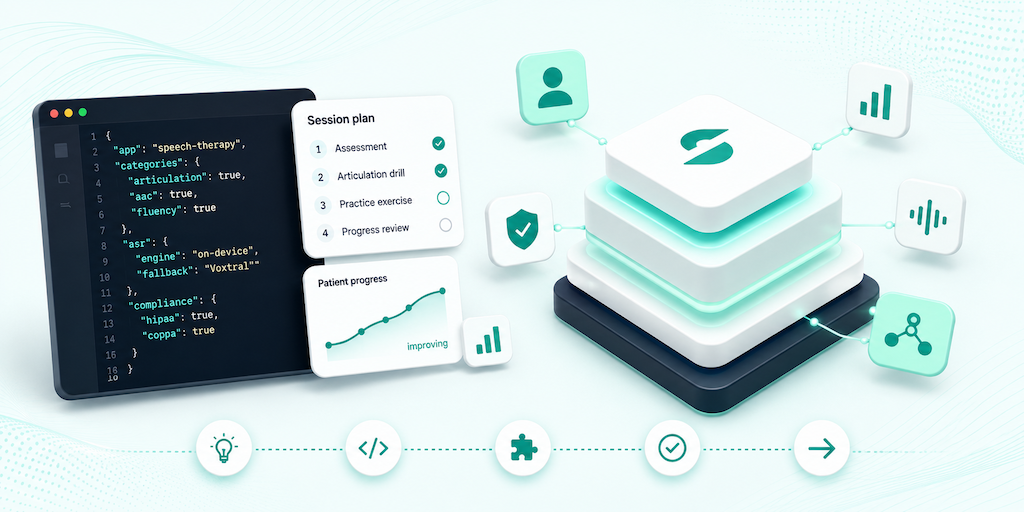
With a multi-agent AI engine built in, you describe outcomes in plain English, and Specode guides you through roadmapping and design, then builds a first working app on HIPAA-ready rails. A patient intake portal with role-based access takes about 10 minutes. From there you iterate conversationally to refine and extend.
Here's the reality: most "healthcare-friendly" platforms are general-purpose builders with HIPAA bolted on. Specode is the inverse, a healthcare platform that happens to be fast.
- Zero compliance retrofitting: every component ships HIPAA-ready with encrypted databases, audit logs, and secure data flows, no Enterprise upgrade required.
- Healthcare AI builder, multi-agent under the hood: a guided flow takes you through roadmap and design, then assembles a working build on HIPAA rails, ready for live preview and iteration. Connect your data early, flip on EHR/EMR, labs, pharmacy/eRx, insurance, and payments through the integration switchboard, lean on guardrails like Change Log and role-scoped testing, brand it fully, and export the code anytime with no lock-in.
- Skill-based architecture, growing weekly: every healthcare capability is a self-contained skill, workflow ones like scheduling, intake flows, clinical dashboards, messaging, and patient onboarding, plus integration ones for EHR connectors, Stripe, Mailgun, and CometChat. Each new skill expands what every project can do, so the library compounds while you build.
- Code ownership without the coding: you get production-grade, customizable code, then own it completely.
- Clinical workflow intelligence: prebuilt components for telehealth, e-prescribing, EHR integration, patient portals, and care coordination, instead of generic forms dressed up as "healthcare solutions."
- Real cost transparency: clients save 40–60% in dev costs with Specode versus traditional builds, measured on audited projects.
Other platforms make you choose between speed and compliance. Specode gives you both, plus the flexibility to scale, customize, or hand off to your own dev team later.
For healthcare founders who need to move fast without moving recklessly, Specode is the platform purpose-built for the job.
2. Blaze.tech: a HIPAA-capable builder, if you're ready to pay for it
Blaze.tech sells the dream of drag-and-drop healthcare application development with HIPAA compliance included. But here's the fine print: the "HIPAA" part only kicks in once you're on their custom-priced Enterprise plan. If you're a scrappy startup looking to launch fast with real patient data, the entry-level "Internal Apps" plan won't cut it.
Blaze.tech does bring some firepower, though:
- Security-forward stack: SOC 2 Type 2 certification, end-to-end encryption (TLS 1.3), MFA, RBAC, and audit logging, all required for serious healthcare deployments.
- Healthcare-fluent integrations: direct connections to Athenahealth, DrChrono, and Elation, plus tools like DocuSign and Auth0.
- No-code database (Blaze Tables): model structured clinical workflows without SQL gymnastics.
- Real-world wins: the Tempo healthcare staffing marketplace, built entirely on Blaze, shows the platform can handle multi-user scheduling and shift management at scale.
It's a solid contender among healthcare app development services, especially for organizations that can justify the Enterprise-level spend. But don't mistake HIPAA "support" for plug-and-play compliance. You'll need governance policies and smart configurations to stay above board.
3. VSee: a no-code Swiss Army knife for virtual care
If you're building a telehealth platform and want it to just work out of the box without spinning up a dev team, VSee deserves a look. Think drag-and-drop virtual clinics powered by HIPAA-compliant modules and 250+ configurable settings. It's like assembling a digital clinic from Lego blocks, minus the foot pain.
The platform's sweet spot? Helping non-technical healthcare teams launch mobile-ready telehealth services in weeks rather than quarters. Key capabilities:
- Mobile app development without devs: launch white-label patient apps, intake flows, or even RPM dashboards with zero coding.
- Prebuilt workflows: patient self-scheduling, on-call management, automated billing, and eRx, already baked in.
- Low-code extensions: need custom EMR integrations or branded mobile apps? VSee exposes 250+ APIs and SDKs for exactly that.
VSee also plays well with Epic, Cerner, and SMART on FHIR, so you're not duct-taping a tech stack together. For orgs looking to stand up telehealth fast without sacrificing security or user experience, it's one of the most ready-to-run mobile app development platforms in healthcare. Just don't expect it to do everything without some human oversight.
4. Caspio: a veteran low-code player that still delivers for healthcare
Caspio isn't the flashiest name in the no-code space, but it's earned its stripes, especially among healthcare providers who care more about solid compliance and dependable builds than trend-chasing UI libraries.
For a development company looking to ship HIPAA-compliant apps fast (and without hiring a dozen engineers), Caspio's visual builder is a solid bet. It's closer to an enterprise-grade toolkit with guardrails than a drag-and-drop playground.
Here's what stands out:
- Development company-friendly: prebuilt templates, point-and-click builders, and embeddable components make it approachable even for non-technical teams.
- Real HIPAA muscle: dedicated servers, data encryption, audit logs, and BAAs, no fine print. Institutions like Emory Healthcare and NIH-funded apps rely on it.
- Healthcare-focused features: build everything from patient intake portals to lab management and outcomes dashboards using real-world modules.
Is it the slickest interface in town? No. But if you're a healthtech org with real compliance requirements and lean resources, Caspio walks the talk. The interface won't win awards, but it holds up and stays secure.
5. AppMaster: full-stack visual builder with real HIPAA chops
AppMaster is a full-stack visual development platform that goes from backend to native mobile without a single line of code. For healthcare orgs that need secure apps with serious logic under the hood, it punches above its weight.
What makes it stand out?
- True backend generation: under the hood it writes Go for server logic, Vue3 for web, Kotlin and SwiftUI for mobile. You get real code, just visually modeled.
- Secure authentication: two-factor auth, SSO, and biometrics for HIPAA-grade access control.
- FHIR-ready integrations: need to talk to an EHR? AppMaster supports FHIR and REST APIs, with documentation aimed at healthcare developers.
- HIPAA-first environments: encryption in transit and at rest, data disposal policies, and hosting on AWS/GCP/Azure, all wrapped in a BAA.
Use cases span from intake apps and telehealth workflows to AI-assisted informed consent. It's not the fastest tool for non-technical users to pick up, but for teams with product vision and regulatory pressure, AppMaster brings real speed.
6. Baserow: open-source muscle for healthcare data workflows
Baserow plays a different game from the typical healthcare app development services company: it's a no-code, open-source database platform that quietly powers everything from patient portals to lightweight EHRs. If you've ever Frankensteined together spreadsheets and Google Forms to manage clinical ops, Baserow is your escape hatch.
Plain interface, wildly flexible:
- Build real apps without code: patient portals, medical databases, scheduling tools, even ER triage systems, built visually and hosted on your domain.
- HIPAA-ready deployments: self-host on AWS/Azure for full PHI control, enforce RBAC, audit logs, encryption at rest and in transit, and get a signed BAA.
- Plays nice with your stack: REST APIs, FHIR-compatible integration, Zapier/n8n automations. Sync it with your EHR or billing system without a dev army.
This is for health orgs that don't want to pay $100/user/month just to track appointments or manage supply inventory. With Baserow, your team gets full control, security, and customization without writing a line of code. Just add vision.
Specode: a different kind of healthcare app builder
If the other platforms are toolkits, Specode is an entire build system, engineered specifically for the healthcare industry. It delivers the outcomes that matter: clinical-grade compliance, feature-level flexibility, and control that doesn't vanish once you hit "deploy."

Here's what makes Specode different.
AI-generated architecture built for clinicians
Specode starts where healthcare teams start, with real clinical use cases. You describe what the app needs to do (onboarding, vitals tracking, labs integration, whatever the workflow demands) and a multi-agent AI engine takes over:
- Guides you through roadmapping and design before any code gets written
- Builds the app using a healthcare skill library, the AI's know-how for workflow features (scheduling, intake flows, clinical dashboards, messaging, patient onboarding) and integrations (EHR, labs, eRx, Stripe, Mailgun, CometChat)
- Delivers a first working build (say, a patient intake portal with role-based access) in about 10 minutes
- Keeps the skill library growing weekly, so every project on the platform benefits as new capabilities ship
Define-and-deploy is the model here, with a guided multi-agent flow underneath. You steer in plain English ("add appointment reasons," "remove labs") while the engine builds the right HIPAA-ready features against a real, working foundation.
Or your engineers can drop to code without losing the compliance posture. No dev team? Our qualified healthcare developers can take on complex customizations.
Specode knows how to build the hard healthcare features
Specode doesn't hand you a catalog of prebuilt screens to drag around. You describe the feature in plain language, and the AI knows how to build it correctly on a HIPAA-ready foundation, including the integrations with medical platforms that usually eat weeks. Under the hood it leans on tested scaffolding and a library of healthcare skills, the encoded know-how for how each feature should be built. You never touch those parts. You describe the outcome.
So when you ask for the hard stuff, it knows how to build it:
- e-prescribing (eRx) and prescription-routing flows, wired into the right pharmacy networks
- labs ordering and results handling
- telehealth video and secure messaging
- patient onboarding and consent capture
- EHR sync with FHIR-based data mapping
- scheduling and task management shaped to clinical workflows, with audit-ready data handling throughout
It's a builder that already understands healthcare, down to how each feature has to behave to pass an audit.
Kept the keywords that survive the accuracy fix: e-prescribing/eRx, labs, telehealth, secure messaging, patient onboarding, consent, EHR sync, FHIR, scheduling, HIPAA-ready, integrations with medical platforms.
Dev-friendly. Founder-proof.
Whether you're a startup founder bootstrapping your v1 or a CIO scaling your tenth app, Specode doesn't box you in:
- Full code export lets your devs take over at any time
- Works with your preferred cloud (AWS, Azure, Google Cloud)
- No black-box magic, every line is yours, down to the deployment scripts
You get all the velocity of a no-code platform, without the usual "vendor prison."
Built to serve real patient care beyond MVPs
Specode is built for actual patient-facing products. Teams use it to build:
- AI-driven telehealth apps with document parsing and EMR note generation
- Mental health platforms with journaling, mood tracking, and coaching
- Home care tools for real-time symptom tracking, task coordination, and clinician alerts
One of the prominent case studies is AlgoRX, a Shopify-style prescription platform built on Specode. It automated provider workflows, simplified eligibility checks, and helped reduce patient churn, all while staying HIPAA-aligned from day one.
Built from a decade in the trenches
Specode is the distilled playbook from building healthcare software for Topflight clients over 10+ years. After working with Fortune 500s and YC-backed startups, one pattern was clear: everyone was rebuilding the same core blocks. So we productized the stack.
Now, whether you're scaling virtual care or launching a specialty EMR, you get proven components and real control at clinical speed. Just software that serves your business and scales patient care the way the healthcare industry actually needs.
AI builder: build HIPAA-ready apps by talking to your stack
At Specode, we put GenAI to work on the tedious part of healthcare app development. You describe outcomes in plain English, and a multi-agent AI engine guides you through roadmapping and design, then builds a working app on HIPAA-ready rails. You steer, it ships. How it works:
Guided multi-agent flow
The AI walks you through roadmap and design before code gets written, so the first build is grounded in your actual use case. Patient and provider portals come up on HIPAA-ready rails, with admin tooling alongside.
Working app in minutes
A first build (a patient intake portal with role-based access, for example) is live in roughly 10 minutes of development work, ready to share, test, refine, and extend.
Conversational edits
"Remove labs," "modify the patient dashboard," "add appointment reasons," "enable video calls." You iterate in plain English, and the engine rebuilds the components and UI in sequence.
Backed by a growing library of healthcare skills
Those skills are the AI's know-how for building healthcare features correctly: workflow ones (scheduling, intake flows, clinical dashboards, messaging, patient onboarding) and integration ones (EHR, labs, eRx, Stripe, Mailgun, CometChat). The library expands weekly, and every new skill works across every project, so the AI keeps getting better at building your features.
Customize responsibly
Update branding, workflows, data fields, and integrations. Everything stays on HIPAA-oriented rails.
Why it matters: you skip template ceilings, dodge compliance workarounds, keep clinician-grade workflows in scope from day one, and trade "demo-day prototypes" for production paths. Speed with control.
Ready to build without the bloat?
Specode is the healthcare app builder that gets you from spec to HIPAA-compliant MVP in 4-6 weeks, complete with audit-ready data handling, EHR integration, and full code control.
Start building your health app with AI. Launch Specode's healthcare AI builder, describe your flow in plain English, and watch it come up live on HIPAA-ready rails, fully brandable, full code ownership, integrations when you need them.
Frequently asked questions
Where typical no-code platforms are drag-and-drop, Specode is an AI-driven build system that builds real, HIPAA-compliant healthcare apps from your description, then hands you the code.
No, but if you have them, they'll love it. You can build apps in plain English and export full source code when needed, so your tech team stays in control.
Yes. PHI encryption, access controls, audit-ready data handling, and deployment workflows are baked in from day one.
Yes. Audit trails, PHI encryption, access controls, and deployment workflows are baked in from day one—not added after the fact.
Yes. It supports FHIR, HL7, and custom integrations, and it knows how to build EHR sync, labs, and eRx flows when you need them.
Teams typically launch a compliant MVP in about six weeks, depending on your use case and customization needs.