Is Bolt HIPAA Compliant?

Bolt.new can absolutely generate a healthcare app fast — a Bolt.new healthcare app in under a minute, if the demos are to be believed. That’s the seductive part.
The less sexy part is what happens between your prompt, the generated code, Bolt’s AI layer, and the infrastructure sitting behind the “wow, it works” moment. In healthcare, that gap — the Bolt HIPAA compliance gap — is where people accidentally stroll into HIPAA trouble wearing flip-flops and founder optimism.
Bolt, built by StackBlitz, is one of the most capable vibe-coding tools on the market — and the vibe coding HIPAA question is one of the first things healthcare founders ask about it. StackBlitz says Bolt creates apps directly in the browser and that it is powered by WebContainers, a WebAssembly-based environment that runs full development environments inside the browser tab rather than on a traditional remote VM. Bolt’s own help docs also say the product uses Anthropic models and AI agents to turn prompts into code.
That makes Bolt excellent for prototyping. It does not automatically make it appropriate for handling protected health information.
Is Bolt HIPAA compliant for building healthcare apps?
No, not based on Bolt’s current public documentation. Bolt is excellent for fast prototyping, but there’s no public Bolt or StackBlitz documentation offering a HIPAA-specific posture or public BAA path for Bolt, while Bolt’s own docs say requests are sent to Anthropic-powered LLMs.
Key Takeaways
- Bolt is not publicly documented as HIPAA-compliant. There’s no public Bolt or StackBlitz page offering a BAA for Bolt or presenting Bolt as a HIPAA-ready environment.
- WebContainers help, but they do not solve the PHI problem. StackBlitz says code execution happens inside the browser, but Bolt’s docs also say user requests are processed through Anthropic-powered LLMs. Browser-local runtime is not the same thing as browser-local prompt handling.
- Bolt is best treated as a non-PHI prototype tool for healthcare founders. It can help you validate UX and workflows quickly, but its public docs do not support the claim that it is a safe default choice for production healthcare apps handling protected health information.
What Is Bolt.new?
Bolt is an AI-powered builder for websites, web apps, and mobile apps. But when founders search for an AI app builder HIPAA fit, the question gets more specific than what Bolt was designed to answer. On its homepage, Bolt positions itself as a chat-based tool that lets users create apps and websites with AI, while StackBlitz describes the underlying platform as browser-based and powered by WebContainers.
The key architectural pitch is simple: instead of spinning up a classic cloud IDE on a remote server, StackBlitz runs a Node-based development environment inside the browser sandbox. StackBlitz explicitly contrasts this with “legacy cloud-based IDEs” that execute code on remote servers, and says “all compute occurs inside your browser.” WebContainers docs and blog posts repeat that the runtime is a browser-resident micro-operating system running Node.js locally in the tab.
That architecture is a real differentiator. It reduces some of the obvious exposure you get from remote VM-based dev environments. But “better than remote VMs” is not the same as “HIPAA-compliant.” That distinction matters.
How Bolt Works Under the Hood
This is the part non-technical founders usually skip because, frankly, the demo is more fun than the plumbing. But the Bolt.new architecture has direct implications for PHI handling.
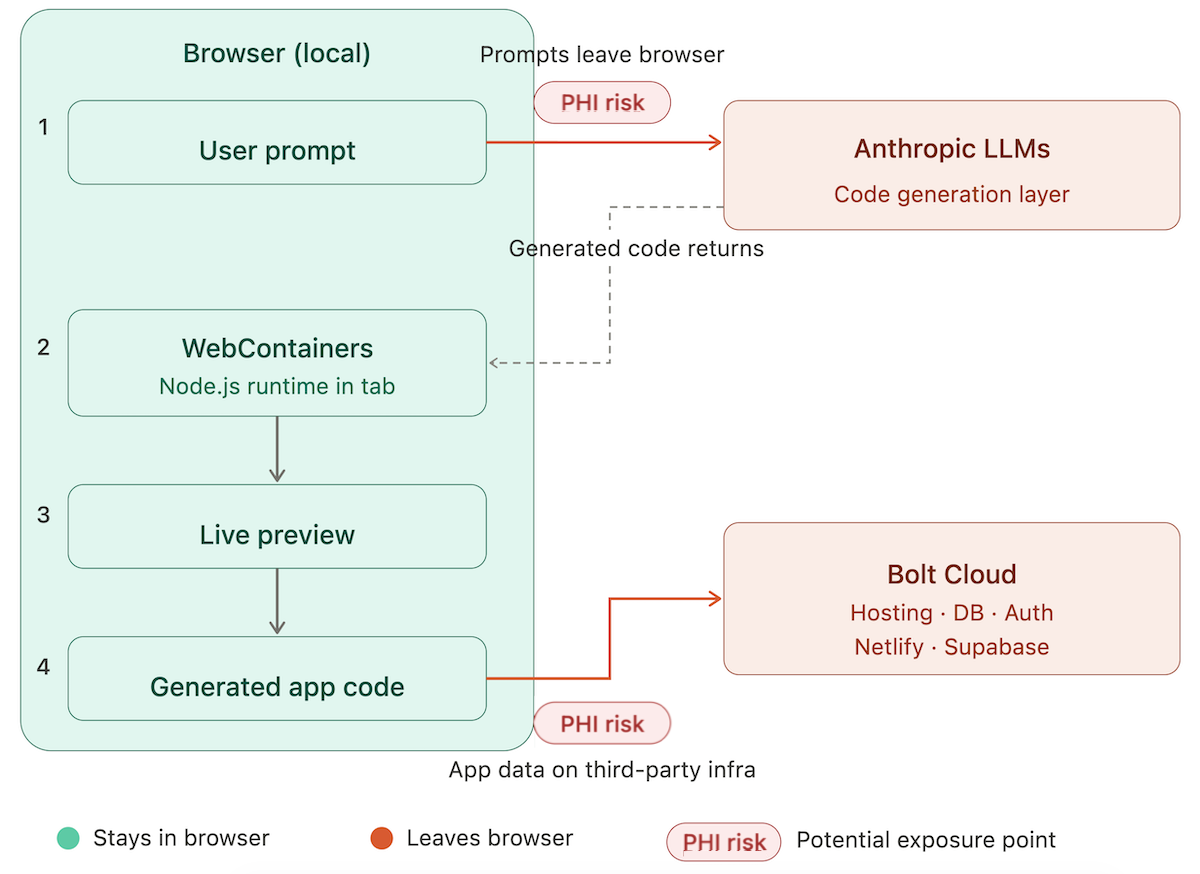
Bolt’s execution environment is browser-based. StackBlitz says WebContainers run the Node environment “securely within your browser tab,” and Bolt’s troubleshooting docs confirm Bolt relies on WebContainers for its full-stack development runtime.
But Bolt is also an AI product. Its help docs say Bolt is powered by Anthropic’s Claude Agent and Claude Sonnet models, and that when you send a request, Bolt sends that request to an underlying LLM. Another Bolt doc says its AI agents are powered by LLM providers such as Anthropic, and that tokens are used when you chat with Bolt, when Bolt writes code, and when Bolt inspects your code changes. In other words, LLM code generation is the core of the product — not an optional feature.
That means two things can be true at once:
- The development runtime itself may run locally in-browser.
- Your prompts and AI interactions still go out to AI services for processing — code sent to cloud-hosted LLMs for generation.
And that second point is the HIPAA landmine. A healthcare founder may hear “runs in the browser” and assume nothing sensitive leaves the machine. That would be far too generous. Bolt’s own AI docs state the prompt is sent to an LLM, which means prompt content is not confined to the local WebContainer.
Bolt Cloud adds another layer. Bolt says its hosting, databases, domains, authentication, file storage, analytics, and server functions are built in, and that these services are powered by platforms like Netlify and Supabase. In other words: even if development feels self-contained, production hosting and app services are not magically detached from third-party infrastructure.
That is not a criticism. It is just how modern app platforms work. But the Bolt StackBlitz HIPAA picture becomes complicated the moment PHI enters any part of this chain. But in healthcare, every service in that chain becomes part of your risk analysis and, where PHI is involved, potentially part of your business associate chain.
Is Bolt HIPAA Compliant?
Based on the public documentation as of April 2, 2026, Bolt is not something you can describe as HIPAA-compliant for handling PHI out of the box.
Here’s why.
First, there is no Bolt HIPAA BAA, no HIPAA-specific posture, and no healthcare-specific guidance in the public documentation. (If you’re not sure why that matters, here’s a primer on what is a BAA and why it’s non-negotiable in healthcare.)
Second, StackBlitz’s privacy policy says the company collects personal information, server log information, analytics information, and may provide information to subsidiaries, affiliates, or other businesses processing data on its behalf. The policy also says StackBlitz uses commercially reasonable safeguards but does not guarantee security. There is some GDPR-related language, but GDPR and HIPAA address fundamentally different obligations. That is not unusual legal language, but it is not the kind of documentation healthcare teams rely on as a substitute for HIPAA contracting and controls.
Third, Bolt’s docs explicitly say prompts are sent to an underlying Anthropic-based LLM. If a user — or a covered entity's team member — includes PHI in prompts, that is no longer just a local-browser event.
So the practical verdict is this: Bolt is fine for non-PHI ideation and prototyping. It is not a safe default choice for building a production healthcare app that will touch real patient data unless you independently validate the entire architecture, contracting, and data flow.
The Specific PHI Risks in a Bolt Healthcare Build
The Bolt.new PHI exposure surface is wider than most founders assume. (For a broader view, see our guide to vibe coding healthcare PHI risks.) Here are the concrete risks specific to Bolt.
1. Prompts Can Carry PHI Before Your App Even Exists
The first HIPAA failure mode is painfully mundane. A founder pastes real patient examples into the prompt so Bolt can “understand the workflow better.” Bolt says user requests are sent to an underlying LLM. That means prompt data containing PHI can leak at the prompt layer before you even get to deployment.
2. Generated Code Is Not PHI-Aware by Default
Bolt can generate code. But AI-generated code is not inherently PHI-aware. It cannot magically classify every field as PHI, apply the minimum necessary standard, implement data encryption at rest and in transit, and architect your safeguards like a healthcare security engineer having a good caffeine day. Bolt’s docs describe strong convenience features, but they do not present the tool as a HIPAA-aware code generation environment with healthcare-specific compliance guardrails.
3. Security Tooling Is Helpful, but Not a HIPAA Program
Bolt does provide database security features. Its docs mention a Security Audit view that can identify issues such as missing row-level security policies and insecure permissions, and allow users to ask Bolt to fix them. That is useful.
It is not the same as a complete HIPAA program covering the full set of technical safeguards required under the Security Rule:
- access governance
- audit controls
- data retention
- incident response and data breach notification
- vendor contracting
- administrative controls
4. Built-In Cloud Services Expand the Vendor Chain
Bolt Cloud includes hosting, databases, auth, file storage, analytics, and server functions, and says it is powered by platforms like Netlify and Supabase. In healthcare, every service in that architecture matters. If PHI enters the system, your security risk analysis needs to account for exactly which entities process it, under what terms, and whether you have the right agreements in place.
5. “Runs in the Browser” Does Not Eliminate AI-Layer Exposure
This is the gotcha. WebContainers reduce one class of risk by avoiding the classic remote-VM model. But Bolt is still an AI service, and its own docs say prompts are sent to LLMs. So the browser-local runtime is not a free HIPAA hall pass. Nice try, though.
What About Bolt’s Enterprise or Teams Plans?
Bolt’s paid and team-oriented offerings do add governance controls. Its Teams docs say new projects are private by default and that admins can control project visibility and integrations. StackBlitz Enterprise also offers self-hosted Kubernetes deployment, SAML-based SSO, integration with private developer tooling, and StackBlitz itself holds SOC 2 certification.
That improves enterprise management. It does not amount to Bolt AI healthcare compliance or a public HIPAA-ready Bolt offering.
That distinction matters because sophisticated infrastructure is not the same as healthcare compliance. Plenty of tools are secure-ish, enterprise-ish, and utterly not what you should feed PHI to. The Bolt.new compliance posture, based on public materials, currently supports the “strong general-purpose builder” reading much more than the “HIPAA-ready health app platform” reading.
Can You Use Bolt to Prototype a Healthcare App Safely?
Yes, with discipline. Using Bolt.new for healthcare prototyping is perfectly reasonable — the key is knowing where to draw the line.
Bolt is a very reasonable tool for:
- UX exploration
- workflow prototyping
- wireframes
- front-end experiments
- non-PHI demos
- internal product validation using fake data only
- early-stage Bolt.new medical app demos for healthcare startup investor conversations
That line stays clean only if you keep all prompts, test records, screenshots, uploads, and integrations free of real patient data. The moment someone pastes in a real patient timeline, a real lab result, or a real intake note because “it’s faster,” you have changed the compliance analysis — and potentially created an unforced HIPAA violation. Not in the fun way.
How Bolt Compares to Other Vibe Coding Tools on HIPAA
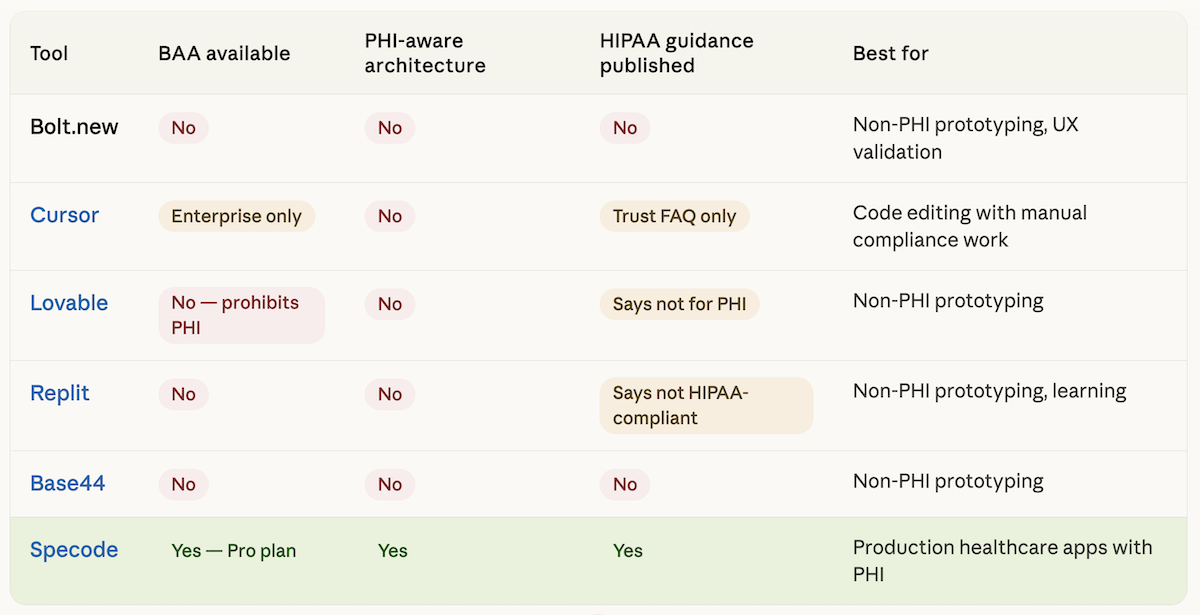
If you are looking for a HIPAA compliant vibe coding tool — or trying to understand the no-code HIPAA landscape more broadly — here is the practical version based on current public documentation. (For a wider lens beyond vibe coding tools, see our full health app builder comparison.)
Here is the tool-by-tool breakdown.
Bolt.new: no public BAA or HIPAA-ready positioning found; good for non-PHI prototyping.
Cursor: Cursor’s trust FAQ says HIPAA BAAs are available, but only for Enterprise customers. For a deeper look, see our analysis of whether Cursor is HIPAA compliant.
Replit: Replit’s own healthcare-oriented site content says its standard hosting is not HIPAA-compliant out of the box and does not sign BAAs for standard hosting services. More details in our piece on whether Replit is HIPAA compliant.
Lovable: Lovable’s privacy and DPA pages explicitly tell customers not to upload HIPAA-protected health information and say the service is not designed for that type of data. That is unusually blunt, which, to be fair, is more honest than the usual startup incense smoke. Full breakdown: is Lovable HIPAA compliant.
Base44: no public BAA offering; not HIPAA-ready. We covered this in detail: is Base44 HIPAA compliant.
Specode: When comparing Specode vs Bolt healthcare readiness, the gap is wide. Specode includes a backend hosting BAA for production deployments and HIPAA-ready infrastructure. The platform is positioned around healthcare-specific auth, data access patterns, and audit-friendly workflows, with the added guardrail that preview/demo URLs are not HIPAA-compliant and should never be used with real patient data.
The HIPAA-Ready Alternative: Building with Specode
If you need a Bolt alternative for healthcare, the comparison comes down to what each platform was designed to do. Bolt is built for speed across general software use cases. The Specode AI builder is positioned specifically for healthcare app delivery. The platform’s production deployments on Pro include HIPAA-ready infrastructure and a backend hosting BAA, so customers do not need to set up a separate hosting account or negotiate a separate hosting BAA just to get into production.
Just as important, Specode draws a much clearer line between prototype and production. Its preview and demo URLs are not HIPAA-compliant and should never be used with real patient data. Before an app goes live, the Specode team also reviews it for security and HIPAA compliance. That is a much more useful healthcare posture than “build fast and hope nobody asks hard questions later.”
On the product side, Specode is framed around healthcare-specific foundations rather than generic app generation: healthcare-aware auth, data access patterns, audit-friendly workflows, custom data models, custom workflows, and full code export with no vendor lock-in — security by design rather than security as an afterthought. The result is closer to a HIPAA compliant no-code builder than anything in the general-purpose vibe coding category. In other words, the pitch is not just speed. It is speed with fewer ugly surprises when the app has to become real.
That is the practical difference for healthcare founders. Bolt helps you get to “look, it works.” Specode is trying to get you to “look, we can actually take this live.” And in healthcare, those are very different milestones. One gets applause on Zoom. The other survives compliance review.
The Better Healthcare Verdict
Developer tools compliance is an evolving space, and no tool should be assumed HIPAA-ready without verifying. If your goal is to prove a product idea fast, Bolt is compelling.
If your goal is to launch a healthcare app that will handle PHI, Bolt’s public documentation does not give enough evidence to treat it as a HIPAA-ready default. The Bolt.new HIPAA compliance picture, based on public documentation, supports a much narrower recommendation: use Bolt for non-PHI prototyping, not as your assumed production healthcare platform.
Frequently asked questions
Based on the public documentation reviewed on April 2, 2026, Bolt does not present a public HIPAA-ready offering for PHI handling, and no public BAA documentation for Bolt found.
No. There is no public Bolt.new BAA documentation. No public Bolt or StackBlitz page offers a BAA for Bolt on any plan.
You can prototype one, yes. For production use involving PHI, Bolt’s public documentation does not provide enough evidence to treat it as a HIPAA-ready default.
Yes, that is the safest use case. Keep all prompts, uploads, and test records synthetic and you avoid the biggest PHI exposure risk.
WebContainers reduce the reliance on classic remote VM-based development because the runtime executes in the browser. But Bolt still sends prompts to an LLM, so WebContainers do not eliminate AI-layer PHI risk.
Bolt.new is a general-purpose AI app builder — you describe any web app in plain English and it generates a full-stack codebase in the browser. It's fast for prototyping, but has no healthcare awareness, no HIPAA-ready infrastructure, and no BAA.
Specode is built specifically for healthcare. Its AI assistant understands clinical workflows and HIPAA constraints, so what it generates includes encryption, audit-friendly data access patterns, and role-based auth by default. You get a BAA on the Pro plan, full code ownership, and production-ready hosting — no compliance retrofitting required.
Most popular vibe coding tools — Bolt.new, Replit, Lovable, GitHub Copilot — don't sign BAAs and aren't HIPAA compliant. Cursor recently started offering BAAs, but only on its Enterprise plan, and it's a code editor, not a healthcare app builder — you still have to engineer every compliance safeguard (encryption, audit logs, access controls) yourself.
Specode is purpose-built for healthcare: HIPAA compliance is baked into every app from day one, a BAA is included on the Pro plan, and the AI automatically handles secure data patterns — giving you vibe-coding speed without the compliance debt.