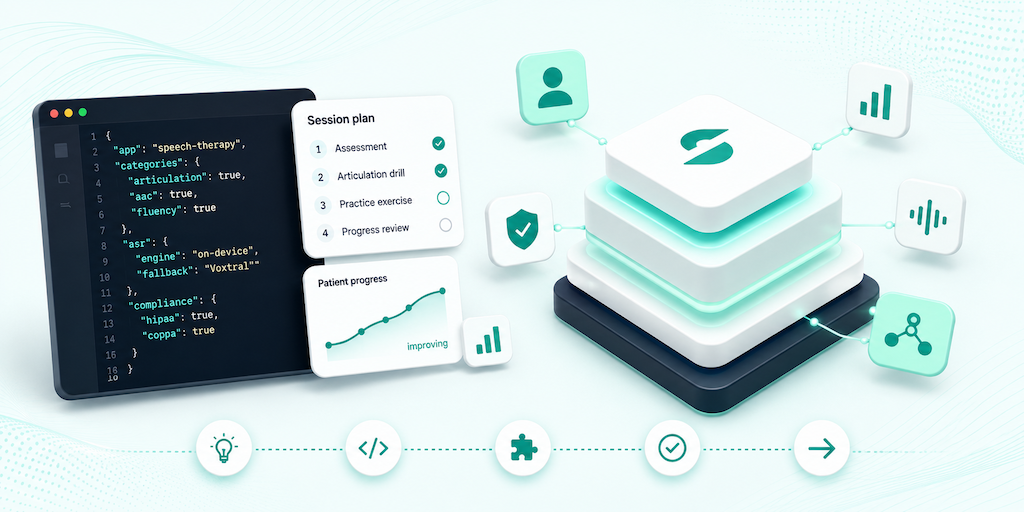
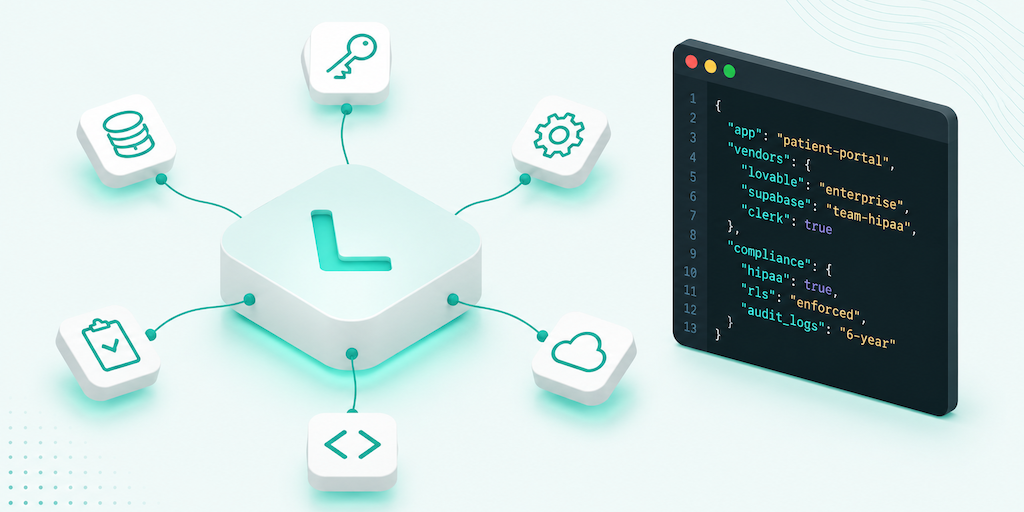
How To Turn A Replit Prototype Into A Serious Healthcare App

Let me guess: you had an idea, couldn't wait to build it, and cracked open Replit (or something like it). A few hours (okay, nights) later, you had a working prototype. Maybe it doesn't look pretty. Maybe it crashes if you breathe near it. But it works. Sort of.
And that's where things get weird.
You've iterated like crazy. You know the user flow inside-out. You've tested your idea enough to know there's something there. But now the real question hits: "How do I turn this thing into a real, compliant, scalable healthcare app?"
Good news: you're not alone, and the path forward is shorter than it looks.
Key takeaways
- Replit is a powerful launchpad, but it turns into a bottleneck the moment you need compliance, scalability, or serious healthcare integrations.Replit gets you to a fast MVP. But healthcare founders hit the wall quickly: no built-in HIPAA compliance, and backend performance that buckles under real load. Knowing when to pivot off Replit is the actual skill.
- Going from prototype to production rebuilds your validated work on stable foundations. You keep what you've proven.Your Replit prototype is a proof of concept. Smart teams run a technical discovery to keep the validated workflows and swap brittle code for compliant, scalable systems that hold up.
- Specode gives you a realistic, production-ready path: a healthcare AI builder on a HIPAA-ready foundation, with full code ownership.You build by chat with instant preview, connect EHR/eRx/labs/insurance, and extend with custom code (yours or ours) to ship a HIPAA-ready app in weeks, not months.
You built a healthcare app on Replit. Now you're stuck.
If that's you, welcome to the club. We see it all the time. Physician-founders, clinical CTOs, and product leads come to us with Replit-powered MVPs and a sinking feeling that they've hit the edge of the map. And they're right.

Here's the deal: Replit is an amazing launchpad, but it's not your runway.
Not if you're planning to store PHI, integrate with EHRs, or survive a HIPAA audit without breaking into a cold sweat.
And yet, starting on Replit was probably the smartest move you could've made. So here's what it's good for, and how to know when it's time to hand over the duct tape.
What Replit gets right for healthcare prototypes
Let's give credit where it's due: Replit is an enabler. For a lot of non-technical founders, especially clinicians moonlighting as product people, it's the first tool that turns a shower-thought into a clickable prototype without calling a developer friend from college.

And if your first prototype came together on Replit? That's initiative.
Instant velocity for non-technical founders
Replit's biggest win is accessibility.
"No background in engineering. No full-stack title. Just vibes, curiosity, and a big-ass dream." – @KarimaDigital
The platform strips away the setup hell that kills momentum. No terminal commands. No config files. You open a browser, start typing, and your idea is running in front of you. For a physician or therapist who's never shipped software, that's the whole game.
AI-assisted development that actually works
The Replit Agent is like a junior dev who never sleeps.
Founders rave about its "magic" for getting unstuck and keeping development moving. Next to other AI-assisted coding tools like Cursor, Replit's in-editor integration scores high on usability and actual usefulness.
"Cursor is good, but Replit's agent is just amazing. Try it yourself and feel the POWER." – @sathvikdivili
That magic fades the second you start pushing real healthcare logic, which we'll get to.
Build from anywhere, even on mobile
Yes, mobile app building. As in, on your couch or waiting at the clinic, shipping a new feature from your phone.
"I love Replit. Made a few apps while hanging out with friends… on my phone!" – @rauldoesnothing
Building this way makes iteration addictive. And in the early days, speed of iteration is the product strategy.
Prototype speed only carries you so far
Replit gets a lot right. The trick is spotting its limits early, especially in healthcare.
In the words of one founder:
"Replit gave me a new world… I could deploy production apps. But once I figured out an app had legs, I had to move it fast."
Translation? Replit is a brilliant launchpad for prototypes, hackathons, and MVPs, and then you hit structural ceilings.
Yes, it's exhilarating to build and deploy your first working app straight from a browser. Yes, the platform carries you through those early wins.
But the moment you're planning for real-world complexity, clinical data and the compliance audits that come with it, you'll outgrow Replit faster than you expect.
Great for building a toy. Not for building a hospital.
When speed becomes a trap: where Replit falls short
Replit gets you off the ground. Then it leaves you midair with a prototype and no landing gear.

Here's what's waiting on the other side of your fast prototype.
Performance bottlenecks hit fast
Replit's infrastructure struggles with serious apps. Developers report slow builds, random crashes, and apps that hang under real backend load.
"Database connections, builds, etc.—it's all so slow and error-prone," one founder vented.
In healthcare, where reliability isn't optional, that's a dealbreaker.
The AI Agent: from wizard to wild card
Early on, Replit's AI feels magical. Then it starts misinterpreting tasks, or just freezes.
"Asked the agent to build an API; it built a UI instead."
In high-stakes healthcare apps, you need precision. Replit's AI is fine for quick fixes. Production-critical logic is a different bar.
Security? DIY and hope for the best
Replit has no built-in HIPAA compliance and no dedicated PHI-safe architecture. There's no enterprise-grade secrets management either.
"Replit always needs API keys for every damn thing," a frustrated developer noted.
Healthcare founders realize this fast: you can't ship patient apps without locking down your infrastructure, and Replit wasn't built for that.
For a platform built for HIPAA-compliant healthcare apps, with security and scaling handled, see our medical app builder breakdown.
Vendor lock-in without a safety net
Once your app grows, migrating off Replit can feel like rebuilding from scratch. Export is far from clean. Costs ramp fast.
"Replit turned into a bad GitHub and lost a lot of users," one critic summarized.
In healthcare, the freedom to move off a platform is what keeps a product alive.
Summary: Replit is a launchpad you outgrow.
When your app needs:
- Staging environments
- Role-based access
- FHIR API integrations
- PHI data encryption
- HIPAA-ready deployments that scale
…you'll spend more time fighting the platform than building the product. If you want the smallest thing that responsibly works (and scales), start with The Leanest Stack to Build Compliant Healthcare Apps.
From prototype to production: what actually changes
So you've hit the ceiling with Replit. Hitting it means you've outgrown the prototype, which is exactly where you want to be. Now it's time to swap the duct-taped logic for real healthcare-grade foundations.

Here's what separates a promising prototype from a production-ready app:
1. Compliance can't be an afterthought
HIPAA compliance in no/low-code app development is a product requirement. You build it in from the start, like any other feature. That means:
- Encrypted PHI at rest and in transit
- Audit-ready tracking of access and activity
- Role-based access controls
- Data segregation for multi-tenant apps
If you're storing patient notes or prescription data, you can't afford to wing it with unsecured environments and hardcoded API keys.
2. Iteration is good. Controlled iteration is better.
In Replit, iteration is wild and fast, and that's fine early on. In production you need guardrails: CI/CD pipelines to push features safely, staging environments to test without blowing up prod, and version control that holds up once a team is committing. You're not hacking in a vacuum anymore. Every commit needs traceability and a safety net.
3. Evolving ideas need modular architecture
Your idea will morph. That's the job. But every pivot shouldn't require rewriting your backend from scratch. What you need:
- Decoupled architecture with swappable logic
- Composable services for things like messaging and auth
- Feature toggles for rapid testing without code rewrites
The right setup lets you stay agile without breaking stuff.
4. You'll need to integrate with the real healthcare stack
FHIR. Epic. Surescripts. Stripe. Zoom for Healthcare. You name it. Integration is what gets your app past the sandbox, so it can't wait. To do that, you need:
- Credentialed environments for trusted data exchange
- Webhook orchestration that doesn't collapse under load
- Reliable API contract enforcement (a.k.a. "Your UI can't YOLO-call things")
If your prototype can't talk to the real ecosystem, it'll stay on the shelf.
5. It's time to build with a real team
You've carried the vision this far. But scaling means letting others contribute without diluting your vision. That means:
- A product manager to capture your brain
- A designer who understands healthcare UX
- Engineers who can ship confidently
- A framework that doesn't throw them into a Replit-shaped corner
Because "do it all yourself" only works until the second stakeholder meeting.
Where Specode comes in: real apps, built on your momentum
To put it frankly: Specode builds your serious healthcare app from the ground up. Fast, compliant, and 100% yours.

You describe what you want in plain English, and the AI builds it, so you're not writing code or dragging blocks around a canvas. And when you want hands-on help, the Specode team has your back, so you stay focused on the vision instead of fighting the platform.
New code, built fast
Specode writes fresh, production-grade code on a HIPAA-ready foundation. The AI understands healthcare constraints, so what it builds fits how healthcare actually works. It builds the features you'd expect: telehealth modules, EHR integrations, labs ordering, eRx flows. What you get is real infrastructure, built to run in production.
Modular code you own
The code Specode writes is fully extensible with no lock-in, modular and swappable, and yours once it's built (full codebase, no catches). The AI builds it to fit your exact needs, so you skip the block-dragging and the midnight StackOverflow sessions.
Built-in HIPAA compliance from day one
Replit leaves compliance to you. Specode builds it in:
- Data encryption
- Audit-ready data handling
- Role-based access
- Secure deployment pipelines
Before you ever onboard your first user, your app is already HIPAA-ready.

AI builder, with real engineers when you want them
Specode's AI builder writes complete, HIPAA-ready flows from plain-English prompts, with instant preview and code you own. You build by chat. When you need more, the team steps in on the Custom tier, adding custom code, deeper integrations (EHR/eRx/labs/insurance), or purpose-built AI agents, without boxing you into a platform.
- Start on healthcare rails: roles, consent, and audit-ready handling baked in
- Integration switchboard: connect what matters, fast
- Guardrails: roll back to any previous state, plus role-scoped testing
- Fully brandable, no lock-in: export anytime
The trick is sequence and ruthless focus. No magic.
Speed without compromise
Typical Specode timeline:
- Week 1: Gather requirements and blueprint the build
- Week 2-3: Build and refine your real working app
- Week 4+: Layer in HIPAA compliance, staging, deployment, and polish
Compared to traditional custom healthcare app development at 6 to 12 months? This is warp speed.
In short
If Replit helped you find your idea, Specode helps you launch it professionally.
- Full code ownership
- HIPAA-ready from the start
- No Frankenstein monster built from old prototype scraps
- Expert support from the Specode team when you want it
Your Replit prototype earned its keep. Now it needs a real plan.
Let's kill the myth: graduating from your Replit prototype doesn't mean scrapping everything. The work you've done carries forward. You refine it.
Your prototype did its job. It helped you validate the idea and learn the workflow inside-out. That's value. But now it's time to replace brittle code with real architecture.
Here's how to make the move without losing momentum:
1. Run a technical discovery
Before you build anything new, step back. A good discovery phase sorts what's worth keeping from what has to go:
- What genuinely worked: the user flow, the core logic
- What you can rebuild on better infrastructure
- What has to be re-architected for compliance and scale
This is where Specode starts: it captures your vision and turns it into a real build map.
2. Keep what works (conceptually, not in code)
We keep your app logic and rebuild it on solid foundations. Your existing feature flow becomes the blueprint. We swap fragile hacks for reusable components and automate the boring stuff:
- auth
- scheduling
- video calls
- EHR connections
Your users shouldn't feel the transition. Your dev stack definitely will.
3. Prioritize infrastructure and compliance
Features are exciting. Architecture is the part that bites you later, so do it now. You'll need to:
- Isolate environments (dev / staging / prod)
- Lock down PHI with HIPAA protocols
- Set up role-based access and audit-ready logging
- Deploy on infrastructure that scales with your user base
Replit can't help you here. But Specode's already done the heavy lifting.
4. Build with a team that gets it
You've flown solo long enough. The next phase needs:
- A product manager who can channel your vision
- Designers who get clinical UX
- Engineers who move fast without breaking security
Plus a platform like Specode to hold it together. You still drive the vision. Now you've got copilots who've landed this plane before.
5. Don't delay the upgrade
The longer you build on brittle foundations, the harder the transition gets.
We've seen it happen: teams get stuck duct-taping prototypes into something passable, right up until it breaks in production or fails a compliance review.
The earlier you make the shift, the smoother and cheaper the path to a serious app.
You're starting smarter, with a validated idea and a real plan. And if your prototype got you this far, you're already ahead of the curve.

Parting advice: from demos to deliverables
If you've built a healthcare app prototype on Replit, congratulations. You did what most never get past. But now's the moment to turn it into something that scales.
Speed got you here. The next phase is about building right.
Secure. Compliant. Scalable. Sustainable.
You keep what you've validated and add a serious plan, a serious team, and a serious platform like Specode, one that gets you from idea to infrastructure without killing your momentum.
You've proven the concept. Now let's launch the real thing.
Frequently asked questions
Not reliably. Replit doesn't offer HIPAA BAA agreements or certified PHI-safe hosting, so even a patched app can fail compliance audits.
Performance bottlenecks surface fast. You'll hit random crashes and a backend that gets fragile under real load. Migrating to proper cloud infrastructure is almost inevitable.
Yes. You fully own the custom code built with Specode, so your internal or external developers can take it over and extend or customize it freely.