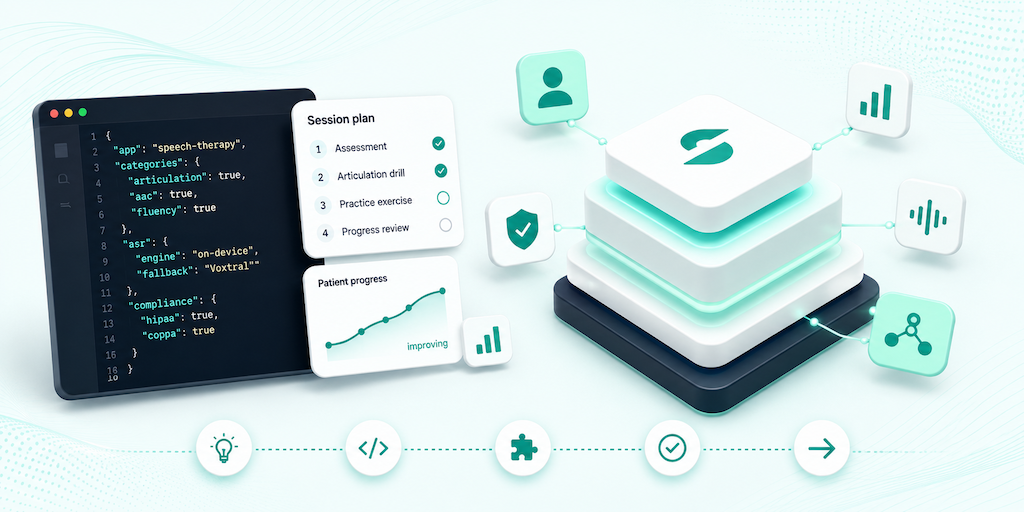
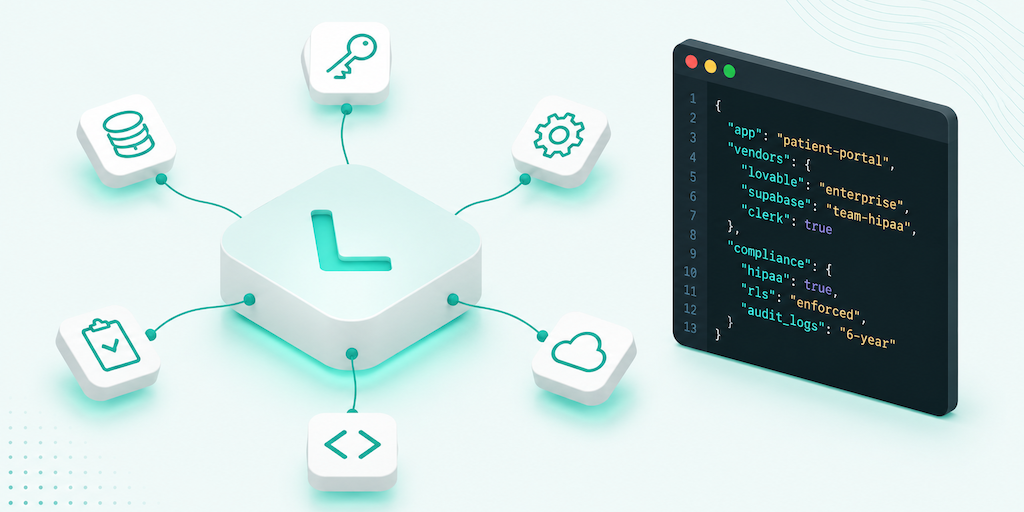
White Label Telehealth Platform Guide 2026: Launch Your Branded Solution in Days

[Updated May 2026]
Key Takeaways
- The smart shortcut: a white label telemedicine app trims 30-60% off dev time, so you skip the boilerplate and go live faster while keeping compliance and customization intact.
- How Specode shortens time-to-value: with Specode's modular architecture and a healthcare AI builder (describe what you want in plain English, see a live preview in minutes), you launch a white-label telehealth platform that fits your workflow without rewriting your tech stack.
- Who this route fits: if you're running care across several sites, scaling a mental health network, or rolling out branded versions for partners, a telehealth white label solution gives you speed and full code ownership.
White label telehealth platform overview
Market demand for white-label solutions
The telehealth boom is still accelerating, and that tailwind creates a major opening for white-label approaches. Estimates put the global telehealth market at roughly USD 196.8 billion in 2025, with forecasts pointing to more than 5x expansion over the next decade (past USD 1.2 trillion by 2034) at a CAGR of ~22.5%.
Another projection has the telemedicine sector reaching USD 432.3 billion by 2032, growing around 19% per year.
Legacy hospitals, clinics, and newer care providers are all scrambling for a slice of that growth, often under regulatory or budget pressure. So demand for telehealth platforms that are fast to launch, brandable, and compliant keeps climbing. A white-label solution is how many of them answer it.
Bottom line: the demand is real and compounding. Telemedicine is a structural shift, and white-label lets providers ride it without rewriting the whole software stack.
Build vs. buy vs. white label: strategic tradeoffs
For many providers, white-label hits the Goldilocks zone. You skip the development overhead and compliance complexity of a custom build, but keep brand identity, room to customize, and the ability to integrate with the systems you already run, which is exactly what off-the-shelf SaaS struggles to give you.
White-label can get a fully branded, HIPAA-ready platform live in under 30-45 days instead of 9-12 months.
ROI timeline for white label platforms
When you strip away the buzzwords, the real question is: how fast does this thing pay for itself compared to a custom build or generic SaaS?
Recent studies and industry reports give us a few hard anchors:
- Telehealth programs in mental health have reported 315% ROI over three years, largely from fewer crisis escalations and better adherence.
- Remote patient monitoring and virtual programs routinely see 4-7x ROI, sometimes breaking even in under 2 months once patient panels hit scale.
- Across providers, telehealth adoption has driven an average 23% revenue increase and 31% drop in operational expenses, with a mean payback of ~6.8 months.
By contrast, building your own telemedicine stack from scratch typically runs 4-8 months of development plus integration and rollout, and many organizations report ~23 months from "we need telehealth" to full-scale deployment.
That's a 2-year runway before you're really compounding returns. A white-label telehealth platform compresses it roughly like this:
Month 0-1: configure and brand the core
You start by mapping your workflows onto a pre-built, HIPAA-ready core (video, scheduling, messaging, auth), then branding the patient and provider portals, configuring roles, and plugging in billing or EHR where needed.
You're spending a fraction of custom dev cost here, because you're not paying to reinvent commodity features.
Month 1-3: revenue starts landing
The first cohorts of patients and providers onboard and visit volume stabilizes. On a per-visit basis, telehealth episodes typically run ~$100 cheaper than in-person for payers and employers, and can be $80-$120 cheaper than traditional acute care in some programs. As follow-ups, chronic care, and triage shift online, you capture both new revenue and freed-up physical capacity.
Month 3-6: operational efficiency compounds
Month 6-12: beyond payback, margin and scale
Telehealth settles in at 10-20%+ of visit volume (many systems sit in the 13-17% range long-term), and it becomes a durable, higher-margin slice of your service mix. By now the original platform cost is usually recovered, so extra work on triage, bundles, and memberships drives incremental margin instead of just covering the tool.
The spreadsheet version: custom builds often start to prove ROI right about when a well-run white-label deployment has already paid itself back and moved on to "how do we use this channel to spin up the next service line?"
Success metrics and KPIs
Launch a white-label telehealth platform today and these are the KPIs worth tracking to measure success and justify the spend:
- Time to launch — the faster you go live, the sooner you start capturing value.
- Adoption rate — how many existing patients or new users switch to the platform; high adoption signals real convenience and usability.
- Visit / session volume — how often telehealth visits happen per patient or provider.
- No-show / cancellation rate — telehealth should cut friction, so lower no-shows mean higher utilization.
- Cost per consult — savings vs in-person visits across staff time, admin overhead, and space.
- CAC / LTV — with branding and flexibility, you can tune for retention, upsells like subscriptions and packages, or ancillary services.
- Operational efficiency — admin time saved, fewer manual workflows, faster billing cycles.
- Scalability / infrastructure cost per user — as you add users, how fast does marginal cost grow? Modular white-label platforms tend to keep it low through reuse and built-in interoperability.
Track a handful of these from day one and you'll know whether to iterate or scale long before the finance team asks.
Understanding white label telehealth solutions
Building a telehealth app from scratch used to be the default, until teams clocked that they were burning six figures and 9+ months on the boring parts: auth, video, messaging, appointment workflows, and all the HIPAA plumbing that never makes the marketing deck.
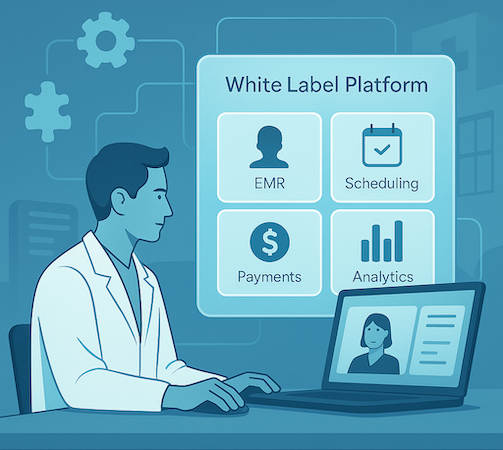
A white label telemedicine platform changes the model. Instead of building from the ground up, you start from a proven core (patient and provider portals, virtual visits, scheduling, payments, messaging, analytics, all wired for compliance) and shape it around your brand and workflows.
For health systems and digital health companies that need a branded digital health solution this year rather than after the next budget cycle, that's a very different game.
White label vs. custom development: where the money actually goes
Custom development gives you total control at a very real cost. Building from the ground up, you're paying for far more than features: requirements discovery, architecture, compliance hardening, integrations, and years of ongoing maintenance. The first release is usually the most expensive prototype you'll ever ship.
A white label approach starts from an opinionated, battle-tested baseline:
- Core telehealth flows (intake, triage, visit, documentation, billing) are already implemented.
- Security, HIPAA safeguards, and auditability are baked into the platform instead of bolted on at the end.
- Your team spends its energy on differentiation: clinical model, care programs, UX, instead of reinventing generic infrastructure.
You still get room for edge cases and custom integrations, but you're not waiting 12-18 months to find out whether the fundamentals even work.
White label vs. off-the-shelf SaaS
Off-the-shelf tools promise speed: "sign up today, launch tomorrow." That's fine if you're a small clinic willing to live with someone else's brand, workflows, and roadmap. It's less fine when you're a health system running serious digital health initiatives under your own flag.
Generic SaaS platforms typically box you in:
- Fixed branding and UX that can't reflect your care model.
- Limited integration paths (or pricey "enterprise" tiers) to reach your EMR, CRM, or rev-cycle stack.
- Roadmap risk, since your core digital health solutions now ride on a vendor's priorities.
A white label telehealth platform sits between pure SaaS and pure custom. You get an owned, branded experience across web and mobile, you can configure flows, roles, and data models to match your service lines, and you can still move fast because 80% of the baseline telehealth logic is already wired up.
So you're not trapped in someone else's product, and you're not paying to build your own from zero either.
Private label vs. white label: what actually differs
"White label" and "private label" get used interchangeably, but there's a useful distinction:
- White label usually means a shared core product that multiple organizations brand and configure, on a common codebase and infrastructure.
- Private label implies more isolation: a dedicated environment, deeper customization, or stricter data and integration boundaries tailored to one organization or network.
For most health systems and care networks, the question worth asking isn't the label, it's the control surface:
- Can you enforce your own security and governance policies?
- Can you model your specific roles and care pathways?
- Can you scale to multiple service lines or regions without building a Frankenstein stack?
Good white label platforms give you enough "private label" control where it counts (data, roles, integrations) without losing the economies of reuse.
What's actually in the stack
A serious white label telemedicine platform is more than a video widget and a calendar. The stack typically spans:
- Frontend applications for patients, providers, and admins (web and mobile), built for accessibility and clinical-grade reliability.
- Backend services for identity, permissions, scheduling, visits, messaging, and payments.
- Data and compliance layer with PHI-aware schemas, audit logging, retention policies, and encryption in transit and at rest.
- Integration fabric for EMR/EHR systems, billing, eRx, lab vendors, and analytics.
- Extensibility points so you can plug in AI intake, decision support, or remote monitoring without rewriting the core.
This is where platforms diverge. Some are glorified video chat with a logo slapped on. Others are closer to a healthcare-grade app framework built for long-term reuse across programs. When you evaluate options, you're buying an architecture your team has to live with for years, not just a feature list.
Total cost of ownership is where white label wins
Upfront license fees are the visible part of the iceberg. Total cost of ownership is everything below the waterline:
- Months of engineering time spent on infrastructure instead of care models.
- Compliance reviews, security remediation, and penetration testing.
- Integration work across EMR, billing, CRM, and reporting systems.
- Ongoing maintenance as regulations, payer rules, and clinical workflows shift.
With a white label approach, a large chunk of that cost moves from "custom project" to "platform capability." You amortize security, compliance, and core feature development across many deployments instead of footing it alone.
That's why, over a 3-5-year horizon, white label often beats both raw custom builds and loosely stitched off-the-shelf tools on TCO, especially when your telehealth stack supports multiple service lines and regions.
If you want to go deeper on budgets and resourcing trade-offs, our telemedicine app development guide breaks down the cost structure of building a telehealth app from scratch vs building on a more opinionated foundation.
Looking to launch a compliant telehealth solution under your brand? Let's build it together.
What a white label telehealth platform is actually made of
Specode's white label telehealth platform isn't a static product you inherit and freeze. Every core feature below is part of a modular system: continuously updated, HIPAA-compliant, and customizable to your clinical workflows today and whatever your roadmap throws at you tomorrow.

The frontend is what users judge first
It's the first thing your users see, and the fastest thing they judge you on.
- Fully brandable patient and provider portals (colors, typography, logo, navigation)
- UX variations for specialty use cases (behavioral health, urgent care, home health)
- Role-aware UI components with clinical task prioritization
- Mobile-first layouts with accessibility built in (WCAG 2.1 AA)
When digital health solutions feel generic, users assume the care will too.
The backend that makes it a clinical system
White label doesn't mean front-end lipstick. Behind the UI sits a real healthcare-grade engine: microservices for scheduling, encounters, documentation, and messaging, a PHI-aware data model aligned to clinical workflows, a unified identity and permissions service (SSO, MFA, OAuth, SAML support), and task orchestration for follow-ups, escalations, and longitudinal care.
That's the difference between a telehealth widget and a clinical system.
The frontline features your MVP can't skip
Any serious private label telemedicine solution has to nail the basics, because "we'll fix it post-launch" is how budgets quietly leak. Here's what your MVP actually needs:
- Secure video consultations: encrypted, compliant, and resilient on low bandwidth. No pixelated freeze-frames mid urgent-care visit.
- Asynchronous chat and real-time messaging: for pre-visit intake, post-visit follow-up, or mid-visit clarifications.
- EMR-lite or full EHR integration: view, edit, and sync patient data, yes, including SOAP notes and labs.
- Scheduling and reminders: custom time slots, availability rules, and push/email notifications to keep no-shows low.
- Branded patient portal: access to health data, care plans, messages, and appointments, and yes, it should work beautifully on a mobile app.
This foundation powers most of the top 18 telehealth apps for doctors and patients, and with Specode's white label telehealth platform you get it pre-built, pre-secured, and fully brandable.
The controls your compliance officer will grill you on
The administrative layer is where infrastructure gets scrutinized:
- Role-based access controls: segment permissions for front-desk, clinicians, billing, and admin staff.
- Admin dashboards: platform usage, billing data, and user analytics in real time.
- Secure payments: PCI-compliant, with co-pay capture and payment histories.
- Rich provider and patient profiles: credentials, NPI, insurance info, and medical history.
Cohesive modules that actually play nice together, instead of a duct-taped pile of plug-ins.
Security and compliance, by default
Compliance here is failure prevention, built into the architecture rather than added at the end.
- HIPAA-aligned data retention and access logging
- Encrypted communication (TLS 1.2+ end-to-end)
- BAA support and automated audit evidence
- Least-privilege defaults with breach containment patterns
- Zero trust network posture, segmentation, and key rotation
This is the part that keeps your name out of the news.
Capabilities that extend the care model
This is where a private label telemedicine app stretches from functional to genuinely useful over time:
- ePharma integration: prescribe meds digitally with formulary checks baked in.
- Remote patient monitoring: connect to devices (BP cuffs, glucometers, wearables) and track vitals.
- Labs ordering and results delivery: trigger orders and deliver results in the patient portal.
- Virtual waiting room: triage patients before a consult to keep providers efficient.
Integrations that fit your ecosystem
A modern telehealth platform has to live inside the systems you already run:
- FHIR / HL7 bi-directional EHR sync
- Billing and clearinghouse compatibility
- Pharmacy and lab integration
- Real-time eligibility and claims insight
- Third-party API governance and monitoring
It lines up with your healthcare mobile app development guide, with no hidden integration debt.
Scaling without a rewrite
Success shouldn't cause downtime. The scaling layer is built so growth doesn't trigger a re-architecture:
- Auto-scaling infrastructure across regions
- Database sharding for multi-site health systems
- Queueing and retries for peak clinical hours
- Uptime SLAs with continuous-deploy safety rails
You go from 5 providers to 5,000 without a platform rewrite.
Mobile and web, one platform
In telehealth, location is just a variable. Web handles hospital workstations and long-form charting; mobile covers in-home care, urgent consults, and messaging touchpoints. Across both, a unified codebase keeps feature parity, secure offline access modes hold up when connectivity drops, and the UI adapts to wearables and sensors. Care happens everywhere, so your platform should too.
Build only what you need
With Specode, you get prebuilt components tailored to your workflow. Skip what you don't need, extend what you do, scale as you grow, on a clean foundation rather than a monolith you'll regret.
Need specific features in your telemedicine app? Our experts will tailor them to your practice.
Building the business case for white label telehealth
Telehealth has become a core service line. The global telehealth market is estimated at ~$123B in 2024, projected to reach $455B by 2030 at ~24.7% CAGR.
It already accounts for up to 17% of outpatient/office visits in the U.S. and has held that share since 2020. So the real question is how to invest without blowing up capex and timelines.

What the ROI actually looks like
Telehealth generates serious returns when it's wired into real care programs rather than left as a one-off pilot:
- Mental health services using telehealth report 315% ROI over three years, with big drops in crisis events and better adherence.
- Remote patient monitoring programs typically see 3-5× ROI with a 2-3-month break-even at modest panel sizes.
A white label telehealth stack doesn't magically create those numbers, but it lowers the cost and time to plug into the same reimbursement codes and care pathways that drive the ROI (RPM, CCM, tele-psych, hybrid primary care).
Speed to market is where white label wins
This is where white label quietly destroys custom builds. Custom telemedicine apps often take 4-12 months to reach production, and some dev shops estimate ≥120 days minimum even for a lean custom telehealth MVP. By contrast, white label telemedicine solutions routinely launch in 1-3 months, with some suites going live in ~2 months depending on customization.
In a market where telehealth is already a stable share of visits, being 6-9 months late means handing those encounters and that recurring revenue to competitors.
How white label contains risk
A credible business case has to answer one thing: what could go wrong, and how do we contain it? White label helps on three fronts:
- Delivery risk: you start from a proven codebase and integration patterns instead of betting on a greenfield build.
- Compliance risk: HIPAA-grade logging, encryption, and workflows are inherited from the platform instead of reinvented (and audited) from scratch.
- Execution risk: you pilot in one specialty or region, then expand, instead of committing a full capex roll-out up front.
The result is a controlled rollout with measurable checkpoints rather than a big-bang go-live.
Where white label gives you an edge
Telehealth is growing quickly, but not evenly. Enterprise systems, retail clinics, and digital-first players are all chasing the same patients in a market compounding at ~25% annually. A white label approach gives you:
- Brand control: your own front door instead of a vendor's portal.
- Service-line agility: spin up behavioral health, chronic care, or employer programs on the same core.
- Unified data: telemetry across virtual and in-person care, instead of siloed vendor dashboards.
That's the difference between "we also offer telehealth" and "virtual is a core distribution channel."
What investors want to see
Digital health is still getting funded: $10.1B in venture dollars in 2024 across 497 deals, with investors skewing toward earlier-stage, capital-efficient plays. And 42% of 2024 digital health funding flowed into AI-focused companies layered on top of existing infrastructure.
Put bluntly, investors are tired of bloated, multi-year platform builds. A white label telehealth strategy with clear capex bounds, 3-12-month ROI modeled off existing telehealth/RPM benchmarks, and a roadmap for layering AI and programmatic care on top is far easier to underwrite than "we'll spend 18 months building our own stack and see where we land."
White label telehealth implementation roadmap
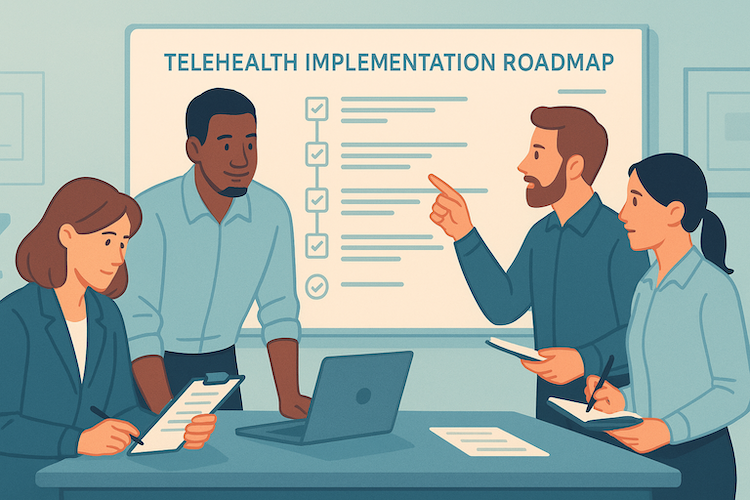
Going live with a white label telehealth platform shouldn't feel like rebuilding a hospital from scratch. The goal is simple: launch fast, launch safely, scale without regrets. This roadmap keeps velocity high while keeping compliance and workflow integrity intact.
Discovery: where ops meets care delivery
This is where ops meets care delivery, well before anyone touches a feature list.
- Identify clinical programs (urgent care, mental health, CCM, RPM)
- Map patient and provider journeys around actual workflows rather than hypothetical happy paths
- Define roles and permission scopes (front desk, MA, NP/MD, billing, admin)
- Confirm regulatory posture (multi-region waivers, PCMH rules, credentialing flows)
The outcome is a deployment-ready scope tied to real reimbursements and usage volumes.
Customization planning
This is where you shape the product around your differentiation and leave commodity features alone.
- Component selection: what's in the MVP vs. deferred to Phase 2
- UX tailoring: specialty-specific triage, templates, documentation
- Analytics and reporting hooks to measure success before launch
- Multi-brand or enterprise network planning, if you're scaling across affiliates
The mantra here: start with what makes you money, refine what makes you unique.
Branding and design
Patients judge your tech on sight, often before they've used a single feature. So brand styling has to reach every surface: the apps, portals, onboarding, and notifications, not just the homepage.
Accessibility-first refinements (font scale, contrast, cognitive load) come in the same pass, and the mobile design gets its own review, since most encounters start on a phone rather than a workstation. Visual trust is clinical trust, particularly in behavioral health and chronic care.
Integration strategy
Telehealth has to fit into the financial and clinical plumbing you already run:
- EHR and billing connections defined in detail (directionality, conflict resolution)
- Labs and pharmacy connectivity, if it's relevant in Day 1 flows
- Insurance eligibility and claims data mapped early, well before launch
- API governance: versioning, failures, uptime monitoring
This is what prevents the classic: "Revenue isn't posting correctly, who owns this mess?"
Testing and QA
Testing has to cover the whole care model end to end, not only the screens:
- End-to-end simulations across intake, triage, visit, documentation, and billing
- Negative path testing: no-shows, disconnects, insurance denial paths
- Security validation: RBAC correctness, audit trails, access revocation
- Load checks for Monday-morning surges and seasonal peaks
Every bug caught in QA saves 10× the effort of catching it once clinicians are in production.
Launch and deployment
Release plans built for minimum risk and maximum confidence:
- Soft launch in one region or specialty, then collect utilization and retention signals
- Provider onboarding playbook (training takes minutes)
- 24-72 hour hypercare post-launch for rapid-fire fixes
- Phased feature unlocks based on measured readiness
Success looks like a predictable go-live and measurable value in the first quarter.
The Specode advantage: AI-powered white label development
Specode is a white label telemedicine platform with a difference: instead of handing you a fixed product, an AI builds your healthcare app from a plain-English description, on a HIPAA-ready foundation, with full code ownership and no vendor lock-in, at a fraction of traditional telemedicine app development cost.
What the AI builds for you
You describe what you need and the AI builds it on a HIPAA-ready foundation: patient dashboard, intake, scheduling, secure messaging, video visits, payments, outcomes tracking, pharmacy flows, and more.
What that means for you:
- Less backend repetition, so faster delivery
- Every feature is built for PHI workflows from the start
- The AI can rebuild or adjust features as your care model evolves
- Code ownership from day one, with no platform ceiling
Specode keeps expanding what the AI can build, so new telehealth use cases get easier to stand up over time.
Everything the AI builds is HIPAA-ready
Everything the AI builds draws on patterns field-tested across real clinical deployments, with PHI-safe defaults (audit trails, encryption, access controls) and provider workflows in mind rather than generic SaaS edge cases. You get enterprise-grade infrastructure without enterprise delays.
How the AI builder works
Specode's platform AI does the heavy lifting:
- Builds workflows through natural-language dialogue
- Acts as a developer and system architect, advising on the best path
- Builds the data models, validation, notes, and UI in seconds
- Uses guardrails drawn from 10+ years of HIPAA-grade app development
- Uses industry-benchmark AI for code generation and "vibe-correct" UX
The loop is prompt, preview, tweak, production-ready app. No AI magic, just sequence and ruthless focus.
Worth noting: AI agents in healthcare can run inside the product too (triage, documentation assistance, eligibility checks), not only in the build process.
Customization framework
When your workflows get complex, good.
- Full control over the app it builds (fields, logic, data, UI, roles)
- Custom code where needed, your team or ours
- Deep system integrations (EHRs, labs, pharmacies, RPM devices)
- Full branding (logo, themes, layout, typography)
A White label telemedicine platform should give you your own front door, your operations, and your care model, not one look for everyone.
Security architecture
In healthcare, security is existential.
- HIPAA-aligned logs, retention, and permissions built in from day one
- End-to-end encryption with PHI-restricted data paths
- Role-based access controls enforced centrally
- Only HIPAA-compliant vendors involved in telehealth, payments, and data exchange
- BAA support and breach-prevention patterns
Compliance is the default here, set up before launch instead of scrambled together after.
Development workflow
Faster cycles, lower telemedicine app development cost, no compromises:
- Build by talking to the AI
- Preview the UX live within minutes
- Iterate on flows, rules, and structure
- Connect your own data early to see real behavior, using test or synthetic records before production
- The Specode team steps in when you're ready for live deployments (PHI, EHR connections)
- Production launch with code ownership and a full compliance review
You stay in control. We remove friction.
Support and maintenance
You're not left alone once you launch:
- Email and asynchronous support at all tier levels
- Product lead guidance for complex feature planning
- Full-service enhancements and maintenance at higher tiers
- Continuous delivery of improvements as the platform evolves
An ongoing subscription means ongoing upgrades, with zero legacy drag.
Faster launches without the hand-coding
Traditional dev moves like a fax machine in a 5G world. With Specode:
- Up to 10× faster than hand-coded stacks (internal benchmarks)
- 30-60% shorter cycles, which lands as direct savings on engineering costs
- Near-instant pivots without re-architecting
- Requirements to pilot-ready in weeks rather than quarters
That speed shows up on the P&L: earlier revenue, fewer sunk costs.
Real example: DyadSync and AlgoRX
DyadSync used Specode to turn chaotic, spreadsheet-and-text-based anesthesiologist scheduling into a focused web platform for freelance surgeons and anesthesiologists. Role-based onboarding, smart scheduling dashboards, contextual in-app messaging, Stripe-powered payouts, feedback flows, and admin analytics were all built on Specode, so the team could streamline case coverage and improve income visibility without funding a multi-quarter custom build.
AlgoRX built a Shopify-style medication storefront on top of our telehealth white label framework. Patients move through guided onboarding and eligibility screening, add multiple medications to a single cart, and check out via PCI-compliant NMI payments, while providers handle credentialing, automated reviews, and secure chat from one dashboard.
The result: a lean ePharma platform for non-controlled medications, built to grow, that reached $1M+ in sales by month 2, hit 7-figure ARR by month 3, and delivered a 12× ROI on Specode.
These are branded, production-grade deployments, not MVPs duct-taped together, and they show what a white label telehealth solution can do when you start from a healthcare-native foundation rather than a generic app skeleton.
Launch your white label telehealth solution in record time, let's talk timelines.
White label solutions by healthcare vertical
From enterprise health systems to nimble digital-first providers, white label telemedicine software creates a faster path to market, with fewer dev headaches and far more control over the patient experience. So who is white label telemedicine platform for in practice?
Enterprise health systems
Large hospitals and IDNs need more than a pretty app. They need brand control, EHR integration, and HIPAA discipline at scale. With Specode, the AI builds custom-branded virtual care across service lines without standing up yet another monolith.
- Branded patient and provider portals on top of existing Epic/Cerner/other EHR flows
- Scheduling, EMR-lite, secure messaging, and telehealth, all built to fit
- Multi-site configuration for affiliates and partner clinics
Use case: A regional hospital chain extending branded telehealth to dozens of satellite clinics without duct-taping third-party platforms together.
Specialty practice networks
Multi-location groups in cardiology, oncology, urgent care, pain, and women's health need workflows tuned to their specialty rather than generic templates.
Specode builds virtual pathways for triage, follow-ups, chronic care, and procedures on a shared backbone, so each practice gets its own flavor while operations stay manageable.
Use case: A multi-state specialty network standardizing intake, consults, and follow-ups while letting each clinic localize content and availability.
Behavioral health platforms
Mental health and addiction care live or die on trust, privacy, and continuity. Specode builds the flows they depend on:
- One-on-one and group therapy flows
- Longitudinal tracking (mood, goals, meds)
- Hybrid models (tele-psych and in-person)
Use case: A multi-state group practice delivering mental health services across time zones, with role-based access, flexible scheduling, and secure messaging built in.
Direct-to-consumer healthcare
DTC brands need consumer-grade UX and medical-grade compliance, fast. White label telemedicine software on Specode means the AI builds your subscription programs, asynchronous consults, labs and ePharma flows, and follow-up automation, without building your own stack from zero.
Use case: A virtual clinic offering cash-pay chronic care bundles with app-based onboarding, telehealth, and medication management.
B2B healthcare technology companies
If you're a healthcare app development services company, PBM, TPA, or employer-benefits vendor, speed and reuse matter more than hero engineering. Specode lets B2B players ship client-branded platforms in weeks rather than quarters, reusing the same hardened infrastructure across accounts.
Use case: A services firm delivering white label telemedicine platforms to payers and employer plans, customizing only the 20% that's client-specific.
International healthcare markets
Cross-border telehealth has to respect local regulations, languages, and payer models. Specode supports multi-region deployments with localization, configurable consent flows, and region-aware logic, so the AI can adapt to country-level rules while keeping your core consistent.
Use case: A virtual-first provider rolling out in the U.S., UK, and EU with a shared core but country-specific onboarding, pricing, and compliance.
Bottom line: off-the-shelf SaaS can't flex this broadly. A Specode-powered white label telemedicine platform gives each vertical what it actually needs without forcing everyone into the same cookie-cutter app.
Whether you're a provider or a partner, we'll help you deliver high-quality virtual care.
Enterprise integration and customization framework
Most white label platforms offer surface-level branding and call it enough. But real digital health solutions have to plug into serious infrastructure: clinical records, billing rails, pharmacy networks, lab vendors, and care-coordination systems, without forcing a rewrite of your entire stack.

Specode was built for that world.
Web, mobile, satellite deployments, multi-brand configurations: the backend stays composable through all of it. That's the technical foundation health systems need when they can't afford brittle integrations or vendor lock-in.
EHR / EMR integration
Your clinical system stays the source of truth, and Specode's approach is to meet your EHR where it lives.
- FHIR and HL7-based interoperability
- Secure API pipelines with audit-grade data lineage
- Patient context hand-offs between telehealth encounters and in-person workflows
- Direct mapping to care pathways (triage, documentation, coding, billing)
Whether you think in Epic App Studio or Cerner Ignite, we prevent the fragmentation and duplication of clinical data that's the usual headache when building a telehealth app from scratch.
Payment gateway integration
If you can't get paid, you can't scale, so Specode makes the financial plumbing invisible. PCI-compliant processing, real-time eligibility and copay estimates, and billing that handles both subscription and per-visit models. Revenue tracking folds into your RCM analytics. No "call your vendor to enable it next quarter" surprises.
Laboratory system connections
Telehealth doesn't stop at Zoom calls. Diagnostics matter.
- Orders and results exchange
- LOINC-driven mapping for labs and vitals
- Notification hooks to trigger provider follow-up
- Multi-state lab partner support
This is where many off-the-shelf tools collapse: workflows get stuck at the "lab slip" stage.
Pharmacy network integration
Virtual care without prescriptions is urgent care with no door. Specode supports:
- eRx workflows aligned with regional rules via integrations
- Medication history retrieval
- Configurable formulary controls
- Specialty pharmacy routing
That's clinical decision continuity: the prescription stays tied to the reasoning behind it.
Insurance verification
Coverage ambiguity kills appointment conversion, so we automate the boring parts. Eligibility checks run through clearinghouses, the claims lifecycle stays visible, denial triggers route straight to tasking and remediation, and payer-specific metadata covers compliance. That improves margins directly. CFO-approved ROI territory.
Third-party API management
When your care model evolves, your platform should too.
- AI for triage or documentation, plugged in as a service
- Remote monitoring devices that sync via secure API mediation
- Role-aware integration governance to prevent accidental PHI leakage
- Centralized monitoring for vendor uptime and security posture
This keeps your architecture consistent with the patterns in your healthcare mobile app development guide, instead of a pile of duct-taped SaaS.
Specode doesn't ask your infrastructure to do yoga. Our white label approach adapts to how your organization already delivers care and how you plan to deliver it next year.
Want a scalable backend that bends, not breaks?
Compliance and security in white label platforms
Integration is the part everyone demos. Compliance and operational resilience are the part that decides whether you survive an audit. A credible white-label approach has to deliver the same governance, auditability, and patient-safety guarantees as an in-house clinical system, and that comes from architecture and process. Marketing claims won't get you through an OCR review.

HIPAA compliance architecture
Real HIPAA support is a design system. The controls that carry it:
- Isolation of PHI using role-scoped access controls and tenant-aware data segmentation
- Immutable audit trails for every create/read/update action tied to user identity
- Data minimization so only clinically necessary information flows into each component
- Secure identity planes that separate authentication from care delivery (SSO/OAuth/SAML support)
- Automatic least-privilege defaults to contain the blast radius of a compromised account
The rule of thumb: no feature gets to exist outside those guardrails.
International healthcare regulations
The platforms that scale internationally localize compliance per jurisdiction while keeping one codebase, so product teams aren't rewriting controls for every market. What that looks like:
- GDPR-driven consent models and data residency enforcement
- Region-specific retention windows (EU vs US vs APAC)
- Granular controls for cross-border clinical information exchange
- Support for country-specific certification layers like the UK's DSPT or Canadian provincial rules
Data privacy and protection
Privacy comes down to one thing: data access tracks the clinical reason for it, every time. The mechanics:
- End-to-end encryption across transit and intra-service links
- Segregated keys with automatic rotation schedules
- Event-driven anomaly detection on data patterns like mass exports or out-of-hours access
- Formal governance of third-party access with revocable credentials and scoped tokens
Encryption alone doesn't stop privilege creep. You also need access scoped to the context of each request, and revoked the moment the reason for it ends.
Security audit and monitoring
If you can't observe the system, you can't defend it:
- Continuous vulnerability scanning and dependency inspection
- SIEM pipelines that alert on identity anomalies and failed-access bursts
- Structured log formats that hold up in an external audit (SOC 2)
- Regular penetration tests with remediation SLAs
Compliance has to keep proving itself through telemetry long after the launch review.
Disaster recovery planning
When a clinical system goes down, patients can't get care, which makes downtime a safety problem. A serious white label telemedicine platform needs:
- Multi-zone failover
- Automated backups with restore procedures you've actually tested
- RTO/RPO targets set for patient safety, measured in minutes
- Graceful degradation for telehealth workflows, like fallback comms channels
Resilience only counts if you've rehearsed it. A recovery plan nobody has ever run is just a slide deck.
Compliance documentation
If it isn't documented, it doesn't exist, at least not to your risk officers. What they'll want to see:
- Real-time compliance status dashboards for PHI workflows
- Traceable lineage of controls from requirement to implementation to monitoring
- Pre-written policy templates mapped to HIPAA and GDPR operational standards
- Evidence bundles ready for vendor assessments and payer credentialing
Done well, this turns weeks of audit paperwork into hours of structured validation, which is a real edge when you're selling into enterprise healthcare.
White label telehealth platform pricing guide
Here's the real economics of a white-label telehealth platform, sized the way a founder or CFO would size it: pricing models, build costs, the line items that sneak up on you, and where the return actually comes from. Enough to build a credible business case or pitch.
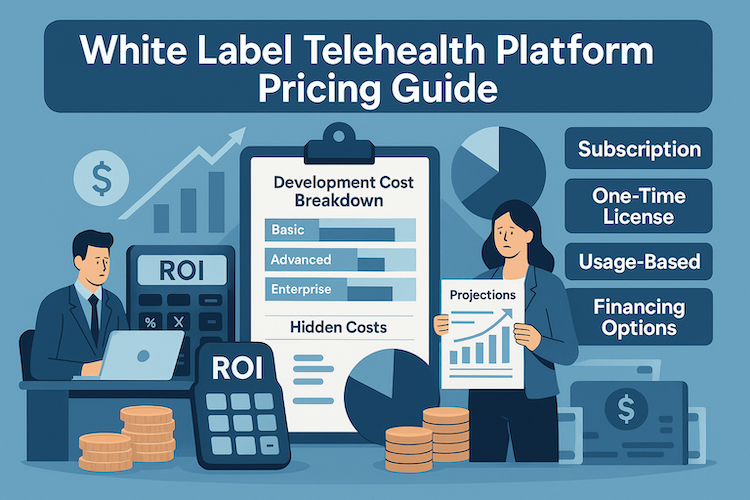
Pricing models
White-label telehealth platforms generally use one of a few pricing models, and the right one depends on your scale and how much risk you want to carry up front.
- Subscription / SaaS model: a recurring license fee (monthly or annual), per user or per facility. Predictable and easy to budget, though it can cap how much you customize or own.
- License plus customization fee: a base license covers core functionality; you pay extra for custom integrations, branding, and tailored workflow logic.
- Usage-based / volume model: cost scales with patient volume, sessions, or data throughput. A good fit for pay-per-visit telehealth without a big upfront outlay.
- Upfront license plus maintenance/hosting contract: trade an initial capital expense for long-term control and a flat operational cost. Attractive for enterprise health systems and large specialty networks.
Each model trades something. Subscription keeps your upfront risk low but can box in flexibility; an upfront license buys control but front-loads cost and risk. The combination worth hunting for is subscription-style predictability with full code ownership, so you're never locked in. Specode runs that way: a flat monthly fee plus the ability to export your entire codebase, which keeps TCO (total cost of ownership) predictable without a six-figure license.
Development cost breakdown
The cost to build telemedicine software from scratch (which white-label lets you skip) varies a lot. Estimates for custom telehealth apps in 2025 run from about $40,000 for a basic MVP to $300,000+ for a full enterprise-grade system. Roughly:
With a white-label telemedicine platform, most of that becomes license or onboarding cost instead of full custom engineering. That cuts your telemedicine app development cost while keeping enterprise-grade capability.
With Specode, most teams start for a fraction of a custom build, turning a six-figure project into a predictable monthly cost.
Operating costs are the part that compounds
Once you're live, the spending doesn't stop. A telehealth platform carries recurring operating costs across:
- hosting and video bandwidth
- security and compliance upkeep
- ongoing support and maintenance
- third-party APIs (video, payments, SMS)
- regulatory work as rules change
Research puts annual operating costs for telehealth services somewhere between ~$137,000 and $1.2 million depending on scale and patient volume, and a common rule of thumb is to budget 15-20% of your initial build cost each year for maintenance and compliance. Over a long enough horizon, that running total can outgrow what you spent to build it. With a white-label stack, more of it stays predictable and contained.
The hidden costs that derail projects
Even with a white-label platform, a few costs get underestimated, usually right where projects derail:
- Compliance scope creep: extra spend on integrations, PHI handling, multi-jurisdiction data policies, and audits.
- Integration entropy: every EHR, lab, pharmacy, and API you add costs more to maintain over time than it did to wire up.
- Scaling overrun: a spike in users or data can blow up infrastructure cost or force a re-architecture.
- Support and change management: onboarding providers, training staff, docs, help desk, version upgrades.
- Regulatory drift: privacy rules, data-residency rules, and reimbursement rules keep moving, and staying compliant keeps costing.
Ignore these and even a "cheap" build gets expensive. That's why clarity on TCO beats a low upfront quote every time.
When white-label pays for itself
Here's roughly how the ROI pencils out over 12-24 months, white-label versus custom:
- Upfront: custom ~$200k, white-label ~$25-50k (license plus customization, varies by vendor)
- Monthly ops/maintenance: $10-20k
- Revenue: ~$75 per consult, 5,000 consults a year, so ~$375k
Even on conservative numbers, a white-label deployment can break even inside 6-12 months. A custom build often takes 18-24 months and still carries more tech debt and scaling risk. Because white-label cuts both capex and time-to-market, the return lands early, which is what matters when you're pitching executives, investors, or payers on a short runway.
Financing options
You don't have to pay for all of it upfront. Common approaches:
- License plus subscription: low onboarding cost, predictable recurring fees, no big capex hit.
- Revenue-share or per-visit pricing: you pay as you go, which fits a slow ramp.
- Staged rollout funding: budget per phase (MVP, pilot, expansion) to cap risk and spread the spend.
- Build-and-white-label hybrid: white-label your core workflows, build custom pieces over time, smooth the cash flow.
These keep telehealth within reach for a small practice, a growing network, or an enterprise testing a new line of business, without a big balance-sheet commitment.
White-label telehealth platforms tend to hit the sweet spot on cost, speed, compliance, and scale. Map out license versus ops versus revenue, plan for the hidden costs, and you've got a lower-risk, faster-payback route to launching digital health at scale.
Technical architecture of modern white label platforms
Under the hood, a serious white label telehealth platform should look a lot closer to a modern banking stack than a glorified Zoom wrapper. Here's what grown-up architecture actually buys you.
Where your PHI lives matters more than which cloud
Most production telehealth deployments land on a major cloud (AWS, GCP, or Azure). The real decision is about isolation and control, and it usually comes down to how you handle tenancy:
- Single-tenant per customer: higher isolation, simpler compliance story, more predictable performance.
- Logically multi-tenant: shared infra with strict tenant boundaries, cheaper, but only if you've got mature security engineering.
- Hybrid: shared app layer, with data and PHI services isolated per tenant or region.
If you run infosec for a health system, "which cloud?" is the boring question. The ones that matter are where your PHI physically lives, how data residency gets enforced region by region, and whether you can move to your own cloud subscription later without rewriting the app. A platform that can't answer those clearly isn't enterprise, whatever the sales deck claims.
A modular monolith beats pure microservices for most telehealth teams
Pure monoliths fall over the minute you add your third integration. Pure microservices drown a small team in operational overhead. For telehealth the sweet spot is a modular monolith that splits out services only where it pays off: keep the core domain flows together (auth and roles, scheduling, encounters, messaging), peel off the high-churn or high-risk domains like payments, notifications, video, and integration brokers, and standardize cross-cutting concerns so every service isn't re-solving logging, auth, and tracing on its own.
If your white label vendor can't explain which boundaries they drew and why, you're buying their future tech debt.
API-first is what lets you actually own the platform
For a white label telemedicine platform, API-first is survival. Every core capability (intake, visits, messaging, billing, outcomes) gets exposed through versioned APIs, with clear resource contracts for patients, providers, encounters, orders, and payments, so your web, mobile, and internal tools all hit the same surface and behave the same way.
That's what lets you:
- bolt your own portals or mobile apps on later
- wire the platform into EHRs, CRMs, and ERPs without brittle screen scraping
- change the UX without touching business logic every time marketing has a new idea
Skip it, and your white label platform is just another SaaS product with your logo on it.
Real-time features have to live inside your security model
Telehealth lives or dies on latency and reliability. Getting the video to connect at all is the easy part; keeping it usable on a bad network is the job. The transport layer usually breaks down like this:
- Video: WebRTC with TURN/STUN fallback, tuned for low bandwidth and packet loss.
- Messaging: websockets or long-lived HTTP streams for real-time chat, presence, and typing indicators.
- Presence and routing: pub/sub layers driving waiting rooms, provider availability, and live queues.
All of it has to be PHI-aware: encrypted streams, scoped tokens per session, hard limits on what metadata leaks to third-party providers. The moment real-time features sit outside your platform's security model, you've built yourself a compliance side door.
The data your visits generate is half the platform
Every visit on a white label telehealth platform throws off data, and that exhaust is the other half of what you're running. Most stacks keep two stores: an operational database for PHI and live workflows, and a separate analytics warehouse (redacted or pseudonymized where needed) for reporting and cohort work.
Sitting on top is a metrics layer that has to answer the questions leadership actually asks:
- utilization
- no-show rates
- revenue per provider
- time-to-appointment
- care-path adherence
Data minimization and access control are the discipline here: most admins never need raw PHI, just aggregates they can trust.
Keep AI replaceable, or you're one vendor pivot from a rewrite
AI in telehealth is only as good as where you bolt it in. The platforms that get value out of it treat AI as a set of swappable services, scoped by where they sit:
- In the build layer: AI assistants that scaffold flows, screens, and data models straight from natural-language prompts.
- In the care layer: triage, documentation help, eligibility pre-screening, and risk scoring, all on PHI-safe patterns.
- In the ops layer: anomaly detection on billing, utilization, and access patterns.
The architecture has to hold a few lines. PHI-touching models stay walled off from non-PHI ones. Audit trails capture what the AI decided or suggested. And you keep the ability to swap one model vendor for another without rewriting the app, because the day AI gets welded into the core codebase is the day a vendor pivot becomes a platform rewrite.
Choosing a white label telehealth development partner
Building a white-label telemedicine app means more than slapping your logo on someone else's dashboard. You're building a branded, compliant digital front door to patient care, and you want it without inheriting a mountain of tech debt. The partner you pick decides which of those you actually get.

Red flags in generic platforms: lock-in and thin support
Let's be blunt. A vendor who can't tell you how to migrate off their platform is selling you a hostage situation and calling it a solution. Watch out for:
- tech lock-in dressed up as "turnkey simplicity"
- rigid templates that don't reflect your patients' journey
- slow or outsourced customer service (your team can't afford delays)
- no real roadmap for HIPAA updates or EHR integrations
And if their devs flinch when you mention Epic or Cerner, run.
The engineering has to survive your team's questions
A white label telehealth partner has to do more than theme a UI. Real due diligence checks:
- Interoperability maturity: FHIR/HL7 proficiency, event-driven EHR sync, bi-directional workflows
- Extensibility: API-first architecture and modular code that won't trap you in their tooling
- Security engineering: least-privilege enforcement, logging, and encryption from day one
- SRE/DevOps practices: auto-scaling, uptime SLAs, zero-downtime deploys, monitoring
If the vendor won't let your engineers talk to their engineers, assume the tech doesn't hold up to inspection.
Domain blind spots become regulatory failures
Digital health is where a vendor's domain blind spots turn into your regulatory failures. A strong partner has the boring stuff down cold: credentialing flows, licensure rules, payer policies, and the PHI lifecycle from consent to access scoping to retention. They design around the real clinical journey:
- intake
- triage
- visit
- documentation
- billing
And they know specialty workflows don't transfer. Mental health doesn't run like urgent care, and neither runs like PT.
Healthcare is a high-context space. Your vendor speaks your language, or you pay to educate them twice.
Support is what you lean on when production breaks
Support determines how fast you recover when production starts throwing curveballs. Press on four things:
- Who's actually responding? Frontend troubleshooters, or compliance-literate engineers?
- How fast is remediation when you're under real pressure?
- What's included in the subscription? Security patches, new features, regulatory updates?
- Is support proactive, or does it only move when you file a ticket?
A white label telemedicine platform is a living system. Buying one without real support is like buying a hospital with no facilities team.
A launch that buckles under growth is a failed launch
A "successful" telehealth launch that breaks the moment volume climbs is a strategic failure. Stress-test for it before you sign:
- horizontal scale under Monday-morning peaks
- region and multi-brand expansion readiness
- performance isolation between tenants or service lines
- analytics that handle thousands of daily encounters, not dozens
Scaling is a now problem. It's the line between a pilot and a business.
Sloppy contracts are the priciest mistake in digital health
Sloppy contracts are the most expensive mistake in digital health. Before you sign, get clear answers:
- Does your team own the code, or just "usage rights"?
- Can you self-host later without a rewrite?
- What happens if you leave the platform?
- Are you locked into a schema or workflow engine you can't take with you?
If ownership isn't spelled out, assume you own nothing except future invoices.
Press hard on references
Any vendor can talk a big game. The real questions cut deeper:
- Do they have live deployments in regulated care models?
- Can you get past the product sponsors to the clinicians who actually use it?
- How did they handle go-live stress, surprise integrations, a compliance audit, a feature pivot under deadline?
And the one that settles it: would the client hire them again? Anything short of an immediate "yes" is your answer.
Where Specode lands on all this
We built Specode for medical practices that want speed and control at the same time. You describe the app you want in plain English and the AI builds it on a HIPAA-compliant foundation, then you customize anything you like, because patient experience moves the needle further than design polish.
With us, you get:
- fast launches, often in under 4 weeks
- an AI that builds and iterates on your app as your workflows change
- full code ownership, no black boxes
- a support team fluent in FHIR and clinical workflows, the kind that's debugged real deployments
And we help you lift patient engagement without bloating your backlog.
Questions to ask before you sign the SOW
- Will I own the codebase of this white-label telemedicine app?
- How fast can we go live with real patients?
- Is this solution compliant out of the box?
- What happens when I need new workflows next quarter?
- How does this compare to the traditional healthcare app development approach?
Launching your white label telehealth platform
A solid white label stack gets you most of the way there. The launch is where you find out whether you've actually built a new clinical channel or just another "pilot we don't talk about."
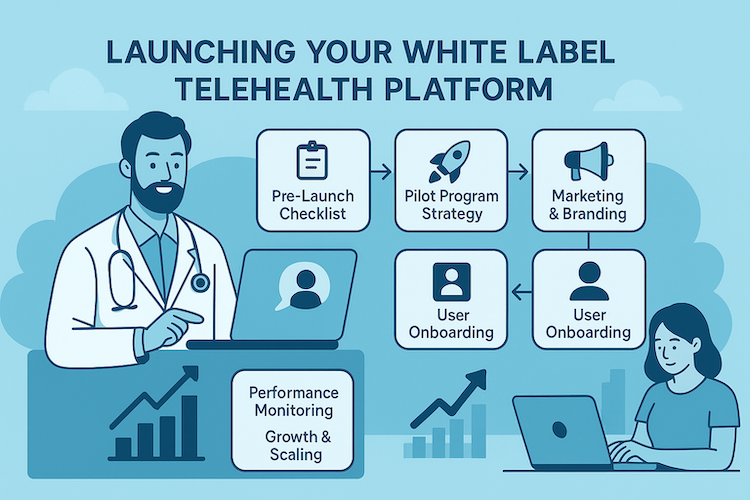
Pre-launch checklist
Before real patients touch the platform, three groups need to sign off: clinicians, operations, and security. Clinicians confirm the full journey works end-to-end; ops confirms staff can actually run that journey; infosec makes sure you won't be apologizing to the board in six months.
Checks to have ticked off:
- End-to-end flow runs cleanly: intake → visit → documentation → coding/billing.
- Role-specific UAT for front desk, nurses/MA, providers, and billing.
- Security and backups tested in practice, not just promised in a slide deck.
Without these, your "soft launch" is really a stress test in production, with real patients in it.
Run a controlled pilot
A pilot is a controlled experiment. You deliberately limit scope so you can see cause and effect. Good pilots usually:
- Focus on one specialty in one region, with a single success metric.
- Run for 4-8 weeks, with weekly reviews of issues, workarounds, and edge cases.
- Split findings cleanly into "must fix before scale" and "can wait until phase 2."
You're trying to prove the model is clinically safe, operationally viable, and worth scaling. Perfection isn't the bar.
Marketing and branding
Telehealth adoption doesn't happen just because a login link exists. You need a consistent story across every touchpoint, so patients and providers know why the channel exists and when to use it. In practice:
- virtual care as part of the main brand narrative
- plain language ("video visit with your doctor" beats "synchronous virtual encounter")
- provider talking points that lead with efficiency and revenue
Your white label telehealth platform is your new front door. Market it like one.
Onboarding is where adoption breaks
Most digital health failures are onboarding failures with nicer UI. Patients need a short, predictable path in; providers need to trust it won't slow them down.
For patients, aim for two things: a 2-3 step path (verify → consent → basic context), and clear expectations about time, tech requirements, and what happens if something fails.
For providers, keep training tight and role-specific: starting visits, finding context fast, documenting efficiently, getting paid correctly.
Decide your metrics before go-live
If you don't pick success metrics before launch, every complaint sounds equally urgent. A small, well-chosen set tells you whether to iterate or escalate. At minimum, track:
- visit volume, no-show rate, and time-to-appointment
- video call success and failure rates
- platform error rates
- support tickets by type, and time-to-resolution
Dashboards and alerts need to exist before go-live. Otherwise your first monitoring system is just an angry inbox.
Scale one variable at a time
When the pilot stabilizes, resist the urge to turn it on for everyone. Scaling is easiest when you change one variable at a time. A sane pattern:
- Add more providers, or more regions, or more service lines, but not all at once.
- Revisit staffing and workflows with each expansion; telehealth shifts who does what, and when.
- Treat every big feature wave (ePharma, RPM, group visits) as its own mini-pilot with a fresh risk check.
That's how you grow a white label telehealth platform into a durable channel instead of a one-off success story.
Future of white label telehealth platforms
White-label telehealth has stopped being a side bet. Over the next few years it's going to be the infrastructure most virtual-care programs run on, and here's how we read the stretch out to 2030.
Emerging technologies integration
Telehealth platforms will soon be hubs for a lot more than video calls and scheduling: remote monitoring devices, wearables, IoT health sensors, home diagnostic kits, and embedded tele-pharmacy.
As care keeps shifting into the home for chronic disease management and remote follow-up, platforms have to handle device data streams, e-prescriptions, patient-generated health data, and asynchronous workflows without breaking a sweat.
The platforms that win treat integrations as first-class modules. The ones that bolt them on later are the ones that end up rewriting their stack just to add RPM or hybrid care.
AI and automation trends
AI's footprint in telemedicine is growing fast. The market for AI in telehealth and telemedicine is forecast to grow at roughly 36.4% CAGR from 2024 to 2030, reaching about USD 27.14 billion by 2030. In practice:
- AI-driven triage, virtual intake bots, and automated documentation that cut clinician load and lift throughput
- Analytics that forecast readmissions and chronic-care adherence, plus resource-demand planning
- Automated admin work (billing, reminders, follow-ups, RPM alerts) that makes platforms leaner and cheaper to run over time
White-label platforms with AI built in move from "a slightly cheaper Zoom plus scheduler" to the operational nerve center for virtual care.
Regulatory evolution impact
As telehealth goes mainstream, the rules keep tightening. Cross-jurisdiction data privacy laws, reimbursement parity rules, remote-care guidelines, and security-standard enforcement will all shape which platforms stay viable.
For white label telemedicine platforms, that means supporting regional compliance variants, audit-ready reporting, consent workflows, and data residency controls, while staying flexible enough to move when the law moves. The platforms that bake regulation in as a core feature will be the ones still standing when the rules shift.
Market consolidation predictions
All those digital-health startups and legacy vendors? A lot of them consolidate. Health systems, payers, and enterprise platform vendors will buy smaller white-label providers to pull virtual-care capabilities in-house. That points toward two tiers:
- Platform-as-infrastructure: large, stable stacks powering many downstream brands
- Niche vertical players: smaller, specialty-focused platforms built around things like mental health or remote monitoring
For buyers, that's the whole argument for code ownership and portability. Get locked into a vendor that gets acquired, and you can be forced into a second migration you never planned for. Worth vetting before you sign, while you still have leverage.
Innovation opportunities
With AI, device data, and regulatory pressure all converging, the next interesting builds are hybrid care models:
- Post-acute care at home: video plus RPM plus e-Pharma plus analytics
- Chronic-disease bundles combining remote monitoring, AI alerts, tele-visits, and preventive care
- Employer- and payer-facing virtual care built under white label, delivered as B2B programs
- Multi-language, multi-region deployments using modular compliance and localization layers
Architect for modularity and extensibility now, and you'll be ready for these long before competitors finish a home-grown build.
2025–2030 market forecast
The numbers back the long game. The global telehealth market, around USD 123.3 billion in 2024, is projected to hit about USD 455.3 billion by 2030, a 25%+ CAGR.
At that scale, white-label platforms that deliver flexibility, compliance, and speed become the default route for providers scaling virtual care, RPM, and hybrid delivery. Get your architecture and compliance posture right early, and you own the rails the next decade of telehealth runs on.
Why choose Specode for your white label telemedicine app
If you want a white-label launch without inheriting a rigid, one-size-fits-all SaaS, Specode sits in the practical middle. You describe the app you want in plain English, the AI builds it on a HIPAA-ready foundation, and you keep full code ownership after launch.
What you get is a production-grade codebase your own team owns and can extend like anything else they build.
The core of it is the AI builder. Describe a flow in plain English (patient intake, a provider portal, a checkout) and the assistant builds the screens, data model, and permissions on HIPAA rails, then shows you a live preview. Connect your own data early so the UI reflects real patients, providers, and payers. From there it's fully brandable, with auto-save and rollback plus seed logins for each role so you can test immediately, and you can drop into the code directly whenever you want.
Here's the range of what the AI builds:
- Scheduling, telehealth video, and visit flows
- Patient intake, e-consent, and health questionnaires
- Patient and provider portals, plus admin dashboards
- Payments and checkout (via Stripe)
- Secure messaging and notifications
- Outcomes tracking and reporting
Underneath, it's HIPAA-first: role-based access, secure messaging, and PHI-safe patterns from day one. On integrations, the AI builds connections to Epic, Cerner, and other major EHRs through their APIs, along with labs, pharmacy, insurance verification, and eRx flows. None of these is a switch you flip. They're real integration work, built the same plain-English, back-and-forth way as the rest of the app, usually across several prompts. And because you own 100% of the code, you launch on Specode's foundation and keep iterating with your own developers, no lock-in.
Specode apps can run multi-tenant, so one build can serve multiple brands or regions. Branding and localization aren't off-the-shelf toggles either: the Design agent handles them, taking your brand direction (or a few reference screenshots) and applying it across the whole app from conversation.
On speed, a working prototype takes about 10 minutes, and a basic production-ready telehealth app runs 1 to 2 weeks, depending on complexity.
AlgoRX: from a multi-week prescribing maze to a Shopify-like medication flow
AlgoRX used Specode to launch a HIPAA-compliant ePharma storefront that automated eligibility, streamlined provider review, and handled multi-product checkout. A prescribing process that used to take weeks turned into a consumer-grade flow.
The results showed up on the P&L: 12× ROI, $1M+ in sales by month 2, and 7-figure ARR locked in by month 3.
What shipped, the parts relevant to a white-label telemedicine app:
- Guided onboarding and credentialing for patients and clinicians, so compliance held from the first tap
- eCommerce plus inline questionnaires that capture clinical context right at checkout instead of in a follow-up email
- Smart pharmacy routing that respects eligibility, geography, and availability without stalling the cart
- PCI-compliant payments (NMI) with discount and affiliate codes that don't break auditability
- Secure provider-patient chat to clear clinical questions before fulfillment and cut abandonment
- Admin and analytics to run meds, providers, and workflows from one pane as demand scaled
"They delivered on the exact day… product far exceeded expectations… hired them for ongoing support." — Adam Hotchkiss, Co-founder, AlgoRX.
With Specode, white label still means your brand and your code. You launch fast on a HIPAA-ready foundation, keep both, and connect the clinical and payment stack you already rely on without duct tape.
Ship a branded, HIPAA-ready MVP fast with Specode.
Let's get your platform delivering real care, fast.
Frequently asked questions
They get used interchangeably, but there's a real distinction. Private label usually implies exclusive branding rights, while white label can be sold to several customers, each running its own branding.
Yes, if you want a professional, branded platform without building from scratch. Just keep it simple enough that it doesn't add steps to your day.
For a compliant launch on Specode, plan on around $10-20K all-in, depending on your integrations. That covers the build, the HIPAA pentest, and the HIPAA-grade service accounts your app connects to.
Yes. Specode handles custom EHR integrations, including Epic, Cerner, and region-specific systems.
Usually 4-6 weeks, because the AI builds most of the app for you. The exact timeline depends on how much customization you need. And the support behind it is healthcare-savvy: real people who know HL7 and have shipped clinical apps, not a helpdesk reading off a script.
With Specode, you get healthcare-savvy support real humans who know HL7, not just helpdesk scripts.
Absolutely. Specode is built for multi-brand, multi-region growth, with the AI extending your app as you add service lines, and full code ownership so you're never locked into a vendor.