Specode vs Knack for Healthcare: What Knack Health Still Can't Do

In early 2026, Knack launched Knack Health, a dedicated healthcare product with its own branding, HIPAA pricing tier, templates, and an AI-assisted builder.
That's new. What hasn't changed is the fundamental architecture: Knack Health is still a no-code database builder with a compliance wrapper. The AI assistant configures tables, pages, and themes. It doesn't generate code you can own, extend, or take with you.
If your roadmap tops out at forms + tables, the upgrade is welcome. If your roadmap includes eligibility, care plans, prior auth, eRx/labs, payer rules, and EHR write-backs, you need an AI that writes real healthcare application code and gives you the keys. That's Specode.
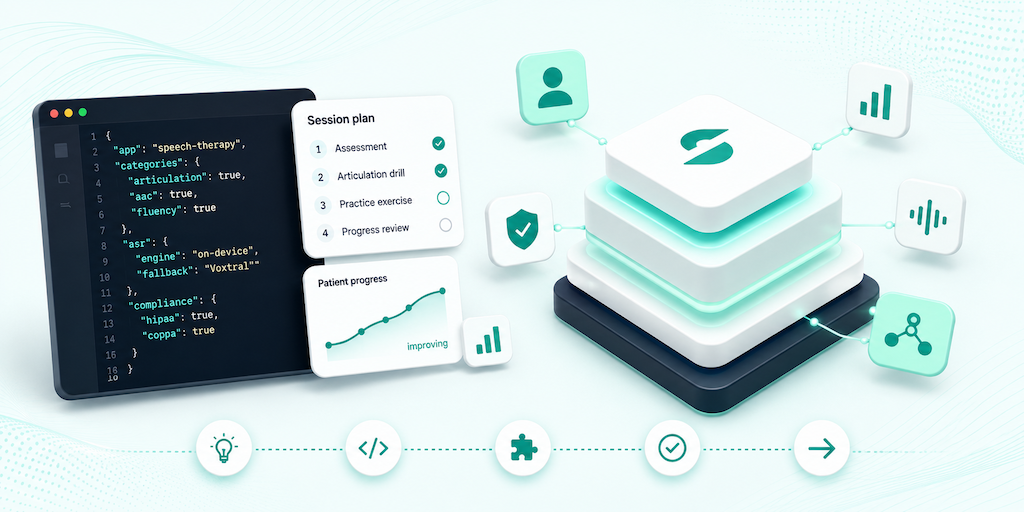
Think of Specode as Lovable for healthcare: a blank canvas where the AI generates your entire front-end and back-end from a prompt, with HIPAA-ready infrastructure underneath. You describe what you need; the AI writes working code. You own every line of it.
Let's compare where each platform shines, and where it quietly hands you a roll of duct tape.
What's the difference between Specode and Knack for healthcare?
Knack Health is a no-code database builder with HIPAA-ready hosting. Its AI configures tables, forms, and page elements but doesn't generate application code. Specode is an AI app builder for healthcare: you describe what you need and the AI generates full-stack code (front-end + back-end) on HIPAA-ready infrastructure, with full code ownership. Choose Knack for internal ops and CRUD; choose Specode when your roadmap involves clinical integrations, custom workflows, or anything beyond what a database template can support.
Key Takeaways
- Knack Health formalizes HIPAA hosting and templates, but underneath it's the same config-only database builder. The AI assistant modifies metadata (tables, page elements, themes). It doesn't produce code.
- HIPAA is the floor. The cliffs are dynamic RBAC, immutable audit trails, prior-auth workflows, and safe EHR write-backs. These are areas where database-first platforms stall, regardless of branding.
- Specode's AI generates full-stack healthcare applications from plain-English prompts, with HIPAA-friendly defaults baked in from the start. You own the code and can extend it however you want.
What Changed: Knack Health (2026)
Knack used to be everything to everyone: CRM, portals, inventory, construction, government, healthcare. In March 2026, they carved out a dedicated healthcare product called Knack Health. Here's what's actually new:
- Dedicated branding and landing page with healthcare-specific messaging, case studies, and templates (patient intake, scheduling, credentialing, care coordination).
- Published HIPAA pricing: HIPAA Core starts at $625/month (BAA included, unlimited users). Enterprise is custom-quoted.
- Healthcare templates for patient portals, intake forms, scheduling, and ops dashboards, available out of the box or through the AI builder.
- Integration claims: 500+ connections, with logos for Athena, Healthie, Cliniko, and Fullscript on the landing page. These run through Knack's existing integration layer (Zapier, Make, webhooks), not native clinical-grade connectors.
What didn't change: Knack Health runs on the same platform architecture. It's still a no-code database builder. The AI assistant still configures metadata (tables, page elements, themes) rather than generating application code. There's no code export, no repo ownership, no escape hatch if you outgrow the platform.
The rebrand is smart marketing. The question is whether it changes the ceiling for clinical workflows.
Knack's AI Builder: What It Actually Does
Knack's AI builder is the centerpiece of their 2026 positioning. They describe it as "prompt to production in minutes" with "zero technical debt." That framing deserves a closer look.
Config, Not Code
When you prompt Knack's AI, it doesn't write application code. It calls internal APIs to update your app's metadata: table names, fields, connections, page elements (grids, forms, charts), theme settings (colors, layout, fonts), and user roles. Knack's platform then renders the UI from that configuration.
This is why Knack is fast for simple setups, and why it hits walls fast for anything that needs custom behavior.
The AI operates across three layers:
- system instructions (from Knack)
- developer instructions (tool definitions, safety rules)
- your prompts
It decides which internal tools to call and what metadata to change. The output is configuration, not code. You never see a codebase, can't version-control it in Git, and can't take it with you.
Where the "No Technical Debt" Claim Breaks Down
"No technical debt" sounds appealing until you need something the config layer doesn't support. In hands-on testing, the limitations surface quickly:
- No scheduled jobs or timer-based logic. Want weekly auto-resetting checkboxes for patient goal tracking (e.g., "drink 50 oz of water daily" with seven boxes that reset every Monday)? The AI builder can model the fields and the card UI, but the auto-reset behavior requires manual configuration of Knack's Tasks or Flows feature, which the AI can't set up for you. In Specode, that's one prompt.
- No deep external integrations. Ask the AI to integrate a HIPAA-compliant messaging service like CometChat for telehealth, and it'll design tables, roles, and pages, then punt the actual integration to "manual setup." It can add a "Chat link" or "Video visit" button that points to an external URL you manage yourself. That's a hyperlink, not an integration.
- UI flexibility is tables, forms, and charts. Knack's AI builds from a fixed set of page elements: Table Elements, Form Elements, Chart Elements, List Elements, and a handful of others. If your patient-facing workflow needs custom interactive UI (progress visualizations, branching intake logic with real-time validation, or anything beyond Knack's pre-built page elements), you're out of the AI's reach and into custom JavaScript territory.
What Knack's AI Is Good At
Credit where it's due: for standing up a structured CRUD app with role-based views, Knack's AI is genuinely fast. If you need a patient intake tracker, a scheduling board with doctor/patient/admin views, or an ops dashboard with charts and tables, it delivers a working app in minutes. The database engine is snappy, and the template library gives you a real head start on common patterns.
The problem isn't the starting line; it's the ceiling. The moment your healthcare workflow needs behavior the config layer doesn't support, you're hand-rolling workarounds in a platform that markets itself as "zero technical debt."
Knack's HIPAA Package: What You Actually Get
With Knack Health, HIPAA is no longer hidden behind an opaque "Enterprise" label. Pricing starts at $625/month for HIPAA Core. That's progress on transparency. But the package itself is still a hardening layer on a database builder, not a clinical-grade platform.
What's Included vs. What's Not
What You Still Have to Assemble
Knack Health gives you secure storage and access controls; you still build the care-delivery logic and regulated integrations yourself, and none of these are claimed as native features:
- E-prescribing & ePA (NCPDP SCRIPT flows, EPCS 2-factor & ID proofing).
- Labs (HL7 v2 ORU, LOINC mapping, or FHIR Orders/Results).
- Eligibility/claims context (X12 270/271, payer rules feeding prior auth & billing).
- FHIR R4 endpoints: your integration targets (EHRs/payers) increasingly expect FHIR R4.
What Their Own Case Studies Actually Show
- Amputee Associates: migrated from spreadsheets; eliminated "data overrides" and coordination chaos. Operations, not eRx or lab routing.
- Arizona Autism: productivity tracking, nursing oversight, timesheets (with Twilio); migrated from Quickbase for cost/UI. Again, operations over clinical integrations.
- Royal Free London/UCL: tissue sample management and research data sharing. Data management, not a clinical ordering interface.
- Social Health Research: a HIPAA-compliant portal for sharing patient stories. Content management, not care delivery.
The pattern is consistent: every Knack Health success story is an operations or data-management win. None involve e-prescribing, lab ordering, eligibility checks, or payer workflows.
HIPAA gets you past the bouncer; it doesn't teach the band to play. Knack Health's HIPAA Core checks the right boxes (BAA, encrypted hosting, audit logs, 2FA), and that's valuable for what it is. But if your roadmap includes e-prescribing, labs, eligibility, prior auth, or anything that involves care delivery, you're not shopping for a database. You're buying down operational risk. And assembling that from generic config parts is where teams lose months and momentum.
The Healthcare Gap: What HIPAA Compliance Doesn't Solve
Clinical operations are exception-driven: insurance flips mid-visit, prior auths bounce, licenses lapse. Database-first tools crack when workflows branch by payer, diagnosis, or state rule.
Where Database-First Platforms Break
The failure mode isn't storage; it's orchestration.
- Credentialing & monitoring: Primary-source checks (boards, schools, cert bodies), DEA where applicable, OIG/state sanctions, malpractice coverage, renewal calendars. Storing fields is easy; orchestrating verifications, re-cred timers, and sanctions alerts is not.
- Telehealth beyond video:
- Adaptive quality + audit trails that survive bad bandwidth.
- In-visit tools: pull PACS images, labs, med histories; document with structured data.
- State overlays: consent/recording rules, cross-border prescribing limits, per-state policies.
- Eligibility (X12 270/271) reality: Transform payloads, juggle payer endpoints/auth, parse 271 responses and AAA rejections, handle retries/timeouts. It's orchestration, not a single REST call.
- Medicare/Medicaid billing logic: Time-based programs (e.g., chronic care, remote monitoring), device-use thresholds, modifier rules, and place-of-service impacts. Prevent double-billing, enforce diagnosis/code pairing, and produce resubmission logic when denials hit.
Real Implementation Walls: Where Knack Healthcare Projects Struggle
Knack Health is fine for calendars and CRUD. Healthcare isn't. The moment you plug into the real ecosystem (e-prescribing, labs, multi-provider ops), templates and config-based connectors buckle.
E-prescribing: Standards, Identity Proofing, Audits
What sounds like "send a script" is a regulated relay:
- Standards stack: NCPDP SCRIPT (current spec, mandated timeline baked in) plus formulary/benefit checks across plan rules.
- Controlled substances (EPCS): identity proofing, two-factor credentials, tamper-evident audit trails.
- Modern endpoints: real-time prescription benefit via FHIR with stricter auth/token flows.
Why this breaks on Knack: you're hand-rolling message validators, credential lifecycles, and immutable logging on a database builder, even with the Knack Health branding.
Labs: HL7/FHIR is not "just JSON"
Lab data is opinionated and unforgiving:
- HL7 v2 ORU: OBR/OBX/NTE segments, delimiters, amendments, critical values, ACKs.
- FHIR R4 adoption rising: orders/results, LOINC mapping, multi-lab quirks.
Where it stalls: edge cases (multi-part results, corrections, STAT alerts) demand a parser + event engine, not formula fields or Knack Flows.
Multi-Provider Coordination Needs Healthcare-Grade RBAC
Roles aren't "admin/user." Daily reality:
- Weekend coverage with time-boxed, patient-scoped access.
- Resident notes requiring attending co-signature.
- Billing visibility without exposing psychotherapy notes (42 CFR Part 2).
Gap: Knack's role system supports unlimited custom roles, but static roles ≠ dynamic, context-aware permissions. Time-boxed delegation and patient-scoped access windows aren't configurable through the builder.
Cures Act Patient Access: "Immediate" Isn't a Toggle
Patients must see their information without artificial delay. The gotchas:
- Results are often released before clinician review; state carve-outs vary.
- You owe granular access logs (who saw what, when).
Need: policy-aware release workflows + audit trails, not a checkbox.
Prior Authorization: Payers' Maze, Your Headache
Where projects really stall:
- Moving parts: payer-specific rules, clinical attachments, live status feeds, denials → appeals.
- APIs: FHIR-based PA with defined turnaround clocks for urgent requests.
Reality on Knack: elaborate forms + manual portal checks. No rules engine, no automated resubmits, no closed loop.
These are orchestration problems with external dependencies. If your stack can't natively handle them, velocity collapses as you scale.
The Hidden Costs of Knack Healthcare Builds
You don't buy a "HIPAA plan"; you buy a stack you can operate. With Knack Health, the bill shows up in layers you didn't scope.
1) $625/month is the floor, not the ceiling
The HIPAA Core sticker price buys hosting, BAA, encryption, and basic audit logs with 125,000 records, 50 GB storage, 10,000 API calls/day, and 100 AI credits/month.
- Overage adds up: additional records and storage are paid add-ons. Healthcare data grows fast: imaging metadata, audit logs, and patient records compound.
- AI credits are limited: 100 credits/month on HIPAA Core. Heavy iteration during build burns through these quickly; you're either throttled or on Enterprise.
- Healthcare plugins: video, SMS, file storage, document signing. Each is "just one more" third-party fee routed through Zapier/Make/webhooks.
- Custom code tax: anything clinical (eRx, labs, eligibility, PA logic) means JavaScript glue, webhooks, and external orchestration bolted onto a no-code platform.
Net: Budget for the platform, then budget again for the parts that actually deliver care.
2) Developer hours to fight healthcare edge cases
The real spend is time, on problems the tool wasn't built to solve.
- Workarounds on repeat: patient-scoped RBAC, time-boxed privileges, tamper-evident audit trails, auto-resetting goal trackers. All of these require manual Tasks/Flows configuration that the AI builder can't automate.
- Parser land: HL7/FHIR transforms, PA attachments, 270/271 eligibility handling, retries/AAA codes.
- Maintenance tail: every payer or lab tweak = another patch. The curve is not linear.
Net: You're not "configuring"; you're building an orchestration engine on top of a database builder.
3) Third-party services to fill the gaps
Each plug-in solves a slice and adds a new failure mode.
- Telehealth: video, waiting rooms, consent/recording, audit events. Knack's AI can add a link button to an external service; it can't integrate one.
- Payments: PCI scope, card vaulting, HSA/FSA quirks, dispute packs.
- Scheduling/Comms: live availability, reminders, PHI-safe templates, SMS/email failover.
Net: Costs, rate limits, and incident chains stack. Coordination becomes your unpaid product.
4) Compliance consulting you didn't plan for
BAAs are paperwork; compliance is product.
- Policy → code: minimum-necessary, access logging, retention/deletion, breach workflows.
- State overlays: consent/recording rules, 42 CFR Part 2 separations, minor access.
Net: Governance becomes feature work. Someone has to own it release by release.
5) Migration when the ceiling appears
Prototypes feel fine until concurrency and audits hit.
- Reality check: multi-role workflows and audit depth expose hard limits at scale.
- No code to take with you: Unlike code-first platforms, there's no repo to migrate. You're exporting data and rebuilding logic from scratch.
- True cost: the new build is expensive; the lost months are worse.
Net: Plan for a bridge or plan for a rebuild. Pretending you won't need one is the costliest choice.
A Quick, Honest TCO Frame
- TCO = HIPAA Core/Enterprise license + Third-party fees + Dev hours (build + integration + maintenance) + Compliance/QA cycles + Migration contingency (with no code portability).
If answers to immutable audits, eligibility parsing, patient-scoped access, retry logic are fuzzy, you're not comparing prices. You're comparing run-rate risk. The invoice for config-first stacks arrives as schedule slip, brittle workarounds, and, eventually, a rebuild, without the codebase to accelerate it.
When Knack Works for Healthcare Use Cases
Knack Health shines when the job is structured data + internal ops, not regulated care delivery. The Knack Health launch made these use cases more accessible, not fundamentally different.
Internal Quality/Ops Dashboards
Great for consolidating multi-site metrics, productivity, schedules, claims status snapshots: replacing spreadsheet chaos with a governed portal. Arizona Autism uses Knack for staff productivity tracking and timekeeping (Twilio check-ins → timesheets). That's ops, not eRx.
Research Data Collection and Registries
Good fit for tissue/sample inventories, consent-bounded access, and research collaboration. Think anonymized/aggregated data access, not clinical ordering. Royal Free London/UCL built a system to manage tissue samples and share data with researchers; speed and access improved, but it's data management, not a lab interface.
Multi-Clinic Admin Portals and Basic Patient Records
Solid upgrade from spreadsheets for multi-location coordination, appointments, and vetted record access. Amputee Associates moved from sheets to a unified app for patient info and scheduling coordination; the value was eliminating "data overrides," not wiring to payers or pharmacies.
Intake Forms for Small Practices
Templates + forms + lists = quick wins for intake, simple triage, and handoffs, especially where you don't need eligibility, prior auth, or device data. Knack Health's new template library makes this even faster to stand up.
MVP Testing Before a Production Build
Useful as a learning MVP to validate workflow and UI with real staff: cheap, fast, reversible. The AI builder genuinely accelerates this phase. Once you need regulated rails (eRx, HL7/FHIR orders/results, X12 eligibility), you're out of template territory.
Quick Rule of Thumb
If success = replace spreadsheets, centralize ops, report on data, Knack Health fits, and now fits more easily than before. If success = deliver care (e-prescribing, lab ordering/results, payer exchanges, Cures-compliant patient access), you've crossed from database building into healthcare orchestration, and that's beyond what even Knack Health advertises.
Or as one of our engineers put it after a 45-minute test drive: "If you want a HIPAA-compliant Google Sheet, choose Knack."
AI Code Generation vs. Database Configuration for Healthcare
Knack lets you model tables and slap forms on top (faster now with the AI builder, but still the same paradigm). Healthcare isn't a contact list with PHI stickers. It's a maze of workflows, exceptions, and regulated endpoints. You don't need more tables; you need an AI that can write the actual application.
How Healthcare Actually Ships with Specode
Specode (right now) is a blank canvas. You describe what you need in plain English, and the AI generates the full application: front-end screens, back-end logic, data models, role-based access, and workflow behavior. It knows healthcare patterns (intake flows, scheduling, telehealth, RBAC, audit trails) because it's been trained on a decade of healthcare builds. HIPAA-ready infrastructure sits underneath.
You're not picking from a menu of pre-fab parts. You're telling the AI what to build, and it writes the code. If the first version isn't right, you iterate in conversation. When you're ready, you own every line and can extend or refactor it however you want.
Database Configuration: Reinventing the Plumbing
Database-first platforms force you into object-making theater:
- New schema for every workflow.
- Custom JavaScript for every eligibility or billing rule.
- Manual Tasks/Flows configuration for any time-based or triggered behavior the AI can't set up.
That's not "configuring a platform"; that's hand-rolling middleware in a drag-and-drop UI.
Side-by-Side Reality Check
Speed, Ramp-Up, and Extensibility
You don't just "use" a database platform. You learn it first.
- Knack Health (real ramp): Yes, the AI builder and healthcare templates lower the barrier. But to ship anything beyond CRUD you still have to internalize: the data object model, view/permission graph, formula logic, Tasks/Flows triggers, the 100 AI credits/month budget on HIPAA Core, and where custom JS/webhooks start. That learning curve eats weeks before you even touch clinical edge cases.
- Specode (build flow): You describe the outcome in plain English. The AI generates the full application, front-end and back-end, with healthcare-aware defaults (RBAC, audit logging, HIPAA-safe data handling). Engineers tighten the edges; you keep code ownership and can extend or refactor as you grow. No platform internals to learn first.
Ramp time compounds. If your team spends cycles mastering a platform's internals, you delay care workflows. Prompt-to-code flips that: days to a working app instead of weeks to workable scaffolding.
Bottom line: Healthcare isn't about "storing data." It's about enabling care delivery. An AI that generates real healthcare applications treats clinical patterns as first-class citizens. Database builders, even rebranded ones, treat them like exotic hacks. Guess which one holds when you scale past the prototype?
Making the Platform Decision: Key Evaluation Criteria
You're not picking a tool; you're picking your next 18 months. Use this as a one-screen checklist you can hand to your team.
1) Map Your 18-Month Reality
- Roadmap: eRx, labs, eligibility/X12, prior auth, Cures-compliant patient access, multi-role RBAC, audit/retention.
- Traffic: expected DAU, concurrent visits, read/write mix, burst patterns (campaigns, flu season).
- Data gravity: which systems are source-of-truth vs derived (EHR, PM, pharmacy, lab, payer).
2) Integration Requirements
- Targets: EHR (FHIR R4), labs (HL7 v2/FHIR), pharmacy/eRx (NCPDP/EPCS), payers (X12 270/271, PA).
- Depth: read-only vs write-back; sync vs event-driven; attachment handling (PA docs, PDFs, images).
- Auth model: OAuth2/SMART-on-FHIR, key rotation, token lifetimes, re-auth patterns.
- Ownership: who runs the adapters, monitors failures, and fixes schema drifts?
3) Security, Audit, and Governance
- Access controls: patient-scoped, time-boxed, context-aware permissions; co-signature rules.
- Auditability: immutable trails (reads/writes/exports), admin actions, retention + deletion policies.
- Breach/IR playbooks: event capture, evidence packs, notification triggers, simulation frequency.
4) Operational Fit
- Ramp time: weeks to grok platform internals vs days to ship flows.
- Team shape: can product/ops drive changes without a platform specialist?
- Change cadence: how safely can you ship weekly (feature flags, sandbox data, rollbacks)?
5) TCO and Runway Risk
- TCO = license + third-party fees + integration build/maint + compliance/QA + migration contingency.
- Ceiling test: what happens at 50-100 DAU with multi-role workflows and deep audits?
- Latency to value: time to first reimbursable workflow (not "hello world").
6) Code Ownership and Exit
- Repo & rights: do you own the code, infra config, and IaC? (With Knack Health: no. With Specode: yes.)
- Escape hatch: how painful is swapping an integration or moving off platform entirely?
- Data portability: export format, re-import plan, downtime window.
Mini Decision Tree
- Need regulated rails in v1 (eRx/labs/eligibility/PA)? → Choose AI code generation with healthcare expertise.
- Expect payer/EHR/lab growth or frequent rule changes? → Choose AI code generation with code ownership.
- All-ops, no regulated integrations (dashboards, intake, internal portals)? → Knack Health can fit.
- Learning MVP only, plan to rebuild later? → Knack Health for validation, budget migration (and know there's no code to port).
Pick the path that minimizes orchestration risk across your roadmap, not the path that looks cheapest on slide two of the demo.
How Specode Delivers What Knack Health Can't
Knack Health hardens a database. Specode generates a clinic. Here's the delta that actually moves your roadmap.
AI That Writes Healthcare Applications, Not Just Database Config
Both platforms have AI builders. The difference is what they produce:
- Knack's AI modifies app metadata: tables, fields, page elements, themes. The output is configuration rendered by Knack's engine. No code, no export, no version control.
- Specode's AI generates full-stack healthcare applications: front-end screens, back-end logic, data models, RBAC, and workflow behavior. It knows healthcare patterns because it's trained on them. Keep iterating in conversation, then inspect or extend the code whenever you want, because there is code.
The AI can generate anything from intake forms with branching and pre-auth hooks, to telehealth flows with waiting rooms and linked notes, to scheduling systems with live slots, to SOAP-based EMR screens with immutable audit trails. You describe it; the AI builds it. Knack's AI can only configure what Knack's platform already supports.
Integration Stance That Matches Reality
Specode's AI can generate integration code for EHRs, labs, and payer systems. For full EHR connectivity, we can bootstrap Canvas Medical; Epic/Cerner/etc. are handled case-by-case via native APIs or middleware. eRx/labs/wearables are via partner integrations, not claimed as universal out of the box. Translation: honest scope, clear path.
Knack Health lists 500+ integrations, but these flow through Zapier/Make/webhooks. The same generic connector layer available to any Knack app. There are no native HL7, FHIR, or NCPDP connectors.
Code You Own, an Escape Hatch You Control
This is the sharpest differentiator. With Specode, you own the repo, extend any part of the generated code, swap integrations, deploy to your infra, with no rewrite tax when you grow. With Knack Health, your app lives inside their platform. If you outgrow it, you export data and start over.
Proof in Market: AlgoRX
Medication storefront + eligibility + provider automation + multi-pharmacy routing. Result:
- $1M+ in sales by month two and 7-figure ARR within six months
- ~12x ROI credited to Specode's AI-generated approach
That flow would require heavy custom workarounds on a database builder, rebranded or not.
If your goal is care delivery, not just data storage, Specode's AI code generation + HIPAA-ready infrastructure gives you production-grade velocity now, and code ownership for whatever's next.
See how fast you can go from idea to a working healthcare app. Book a Specode demo today.
Frequently asked questions
Specode is a healthcare-focused AI app builder: you describe what you need and the AI generates a full-stack application (front-end, back-end, data models, RBAC) with HIPAA-ready infrastructure underneath. You own the code. Knack Health is a no-code database builder with a HIPAA compliance layer. Its AI configures tables and page elements but doesn't produce code. Specode is built for care delivery workflows; Knack Health is built for structured data and internal ops.
They serve overlapping audiences (healthcare teams building apps) but different needs. Knack Health fits teams whose requirements stay within CRUD, intake forms, scheduling, and ops dashboards. Specode fits teams whose roadmap includes clinical integrations (eRx, labs, eligibility, prior auth), dynamic RBAC, and code ownership. If you need regulated rails, they're not interchangeable.
Yes, but expect real rework. Since Knack doesn't export application code (only data), you're rebuilding logic from scratch: role/permission structures, workflow rules, integration wiring, and audit configurations. It's feasible, and we help teams do it, but total effort is usually higher than starting with an AI that generates code you own from day one.
Generated projects default to encryption at rest and in transit, RBAC, audit logs, and environment separation. These are starting points, not a substitute for your own security review and BAAs. For formal security documentation and current architecture specifics, request the latest materials from the Specode team.
Knack's AI builder configures app metadata (tables, fields, pages, themes) using Knack's internal APIs. The output is platform configuration, not code. Specode's AI generates full-stack healthcare applications: screens, logic, data models, and integrations. The key difference: Specode produces code you can inspect, version-control, and extend; Knack produces configuration locked to their platform.
The AI can generate integration scaffolding for common healthcare systems. For full EHR connectivity, we provide a bootstrap path to Canvas Medical and integrate others (e.g., Epic, Cerner) case-by-case via native APIs or middleware. eRx and lab ordering are supported through partners. This keeps you flexible while avoiding bespoke plumbing from scratch.
Knack Health offers HIPAA-ready hosting with a signed BAA, encryption, record change logs, role-based access, and 2FA on their HIPAA Core plan ($625/month). However, compliance depends on how you configure and use the platform. Knack Health's HIPAA package covers infrastructure, not clinical workflow logic, integration security, or operational governance.